
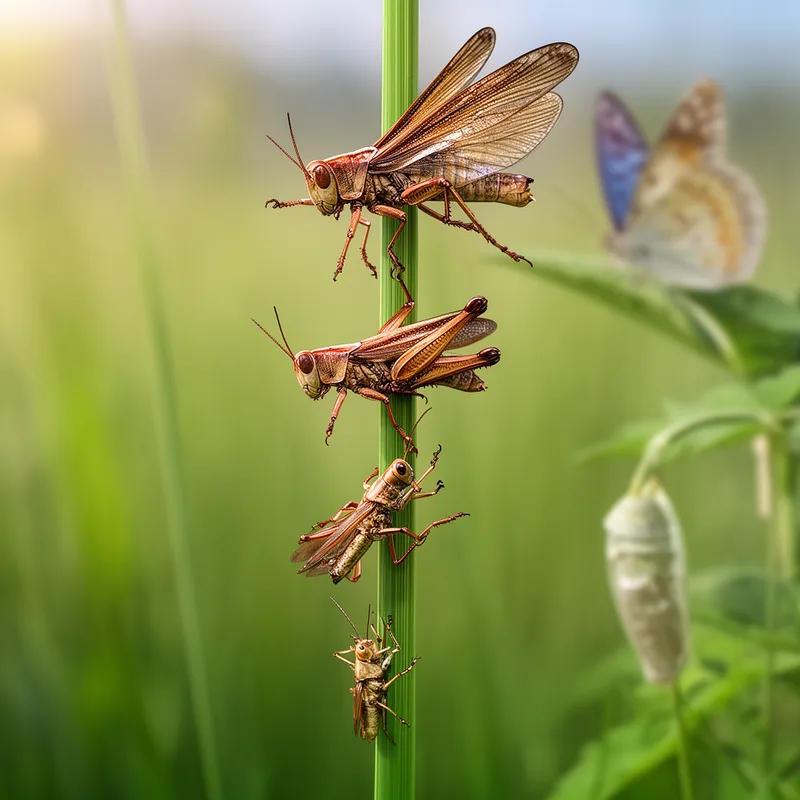
hemimetabolous
- adjective
- /ˌhɛmɪˈmɛtəˌboʊləs/
- Specialized
- Grasshoppers are classic examples of hemimetabolous development.
Examples
-
Unlike butterflies, which have a pupal stage, hemimetabolous insects do not undergo a drastic transformation.
-
Insects like mayflies are hemimetabolous, undergoing gradual changes rather than a complete metamorphosis.
-
Dragonflies are hemimetabolous insects, with young that live in water and differ greatly from adults.
-
The hemimetabolous insects develop through several nymph stages.
-
Many grasshoppers are hemimetabolous and do not have a pupal stage.
-
Dragonflies are hemimetabolous insects that progress through nymph stages, differing significantly from their adult form.
-
Grasshoppers exhibit hemimetabolous development, where the young do not resemble the adults at first.
Synonyms
Insect development where young grow into adults by shedding skins without a pupal stage

An insect whose young live in water and do not look like the adult

An insect whose young live in water and slowly change into adults that look different
How Complete

Surface Forms
Morphology
hemimetabolous = metabolous (semi-transparent) = hemi + metabolous
Formed by the productive prefix 'hemi-' plus the technical adjective 'metabolous', so the structure is interpretable for users with biology or morphological knowledge but may be obscure to average learners.
Etymology
Hemimetabolous breaks into hemi- meaning 'half', as in hemisphere, and metabolous linked to metamorphosis, the idea of 'change'. So a hemimetabolous insect makes a 'half' or partial change as it grows, with young that gradually become adults rather than changing all at once.

