

to fall apart
 193
4.2
193
4.2

- phrasal verb
- /fɔl əˈpɑrt/
- Informal
- He tried to stay strong, but the grief of losing his friend made him fall apart emotionally.
- her world fell apart
- families fall apart
- things fall apart
Loading YouTube…
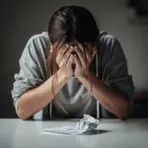
Watch on YouTubeAnd this woman is just falling apart inside the pain.
- And this woman is just falling apart inside the pain.
- So now when things fall apart and you ask who am I?
- So seeing this sort of narcissistic falling apart, you may restart contact.
- And yes, he falls apart in the playoffs, but OK, he's still better.
- But, you know, the world had fallen apart on them.
- And for me, man, I, my entire world falls apart.
- My whole company was destroyed and my whole life fell apart.
- Now in a sense, I want to say it's OK to fall apart.
Examples
-
At this point, she came to see me, stating that "her world was falling apart."
Academic text (2007) -
From the second you gave me that tape, my life has been falling apart.
-
So now when things fall apart and you ask who am I?
-
So we could just watch the world fall apart, I guess.
-
The course to which I dedicated my entire life fell apart in front of my eyes.
Fiction book (1996) -
And this woman is just falling apart inside the pain.
-
All I know is my mother is falling apart in front of my eyes...
Fiction book (1994) -
I was not letting anyone know that my marriage was falling apart, that things were happening.
-
But I'm like, OK, even though my relationship has like fallen apart, at least I still have my job.
-
Some kids are homeless because their families fell apart after divorce, or a parent lost a job or became ill.
Academic text (2011)
Synonyms
 289
7.5
289
7.5
Suddenly stop controlling your feelings and become very angry or upset
 111
3.9
111
3.9
To lose control of your feelings and cry or collapse
 38
5.0
38
5.0
Become unable to cope because of strong stress or emotion
 9
6.1
9
6.1
Lose control of your feelings because of shock or sadness
 9
5.3
9
5.3
To begin to fail, fall apart, or lose control
 5
7.2
5
7.2
To fall apart or stop working properly after being stable
 4
7.4
4
7.4
To have a nervous breakdown because of too much stress
 4
5.3
4
5.3
To suddenly start crying or laughing and lose control
 3
8.9
3
8.9
To lose normal physical or mental ability because of illness
 2
8.2
2
8.2
To lose control of your feelings and act very upset


 1
6.4
1
6.4
To become very upset and unable to think clearly
 1
6.7
1
6.7
Become very anxious, confused, or upset and act in a way that does not make sense

To suddenly become very angry or upset in a way you cannot control

To suddenly lose control of your feelings because you feel overwhelmed

Act in a confused or uncontrolled way because of strong emotion
Antonyms

How Composed
1
4.3

- Informal
61
5.6
350
4.1
- Informal
193
4.2
111
3.9
145
6.5
Surface Forms
Morphology
The literal combination of 'fall' (to move downward or drop) and 'apart' (into pieces) transparently conveys the idea of 'coming undone' or breaking into pieces, so learners can readily infer a physical sense. However, the emotional/mental meaning 'to lose control' is a metaphorical extension of that physical image; it is partially predictable (common cross-linguistically) but not fully derivable without prior exposure.
Etymology
The phrasal verb fall apart is also used for people; one popular image is a person whose life seems to fall into pieces and come apart, so they 'lose control' or 'become very upset'.