

exothermic
 3
6.5
3
6.5

- adjective
- /ˌɛksoʊˈθɜrmɪk/
- Specialized
- That means that the reaction isn't as exothermic as it could be.
- exothermic reaction
Loading YouTube…
Watch on YouTubeSo when you do bond formation, that's an exothermic process.
- So when you do bond formation, that's an exothermic process.
- Because the reaction of dissolving sulfur trioxide into water is an extremely exothermic reaction, generates a ton of heat.
Examples
-
That's because when calcium chloride dissolves in water, it's exothermic, so it actually releases heat.
-
Our calculations clearly show that rearrangements 1 → 2 and 3 → 4 are exothermic processes and could take place with very small energy barriers.
Academic text (2001) -
And so this would favor then the exothermic direction.
-
All of them were exothermic by about that much.
-
The triggered exothermic reaction took less than a minute to work its wonders.
Fiction book (2002) -
The metal oxides react with one another to form an exothermic reaction.
Blog text (27) -
I presume you know this, but just in case, KOH going into water is quite exothermic, so watch out for large amounts of heat generation.
Blog text (7) -
Both of these transitions are exothermic—that is, energy is released when they occur.
Academic text (1992) -
Because the reaction of dissolving sulfur trioxide into water is an extremely exothermic reaction, generates a ton of heat.
-
The methoxide reaction is exothermic, meaning it gives off heat.
Synonyms


 1
8.2
1
8.2
Giving out heat during a chemical reaction
 1
4.1
1
4.1
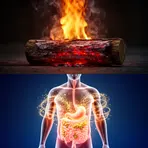
A process that gives off energy, for example burning or digestion
 1
7.4
1
7.4
To make the body produce more heat

A chemical reaction or substance that gives off heat

Producing heat or able to produce heat

A process that releases energy, for example in cells
Antonyms

Compounds

How Exothermic

Surface Forms
Morphology
Etymology
Exothermic comes from the parts exo- meaning 'outside' and therm meaning 'heat', the same root you see in thermometer. So an exothermic reaction sends heat 'out', which is why it releases heat.