

dipole
 1
8.2
1
8.2

- noun
- /ˈdaɪpoʊl/
- Specialized
- As the first pulse passes through the sample, it induces the molecular dipoles to oscillate.
- dipole moment
- electric dipole
- induces a dipole
Loading YouTube…
Watch on YouTubeNitrogen, nitrogen symmetry, no dipole moment.
- Nitrogen, nitrogen symmetry, no dipole moment.
- It's called VADM, virtual axial dipole moment.
Examples
-
The magnetar's internal field is presumed to be even stronger than the external dipole field.
Academic text (2006) -
Final thing I did was what happens when you put a dipole in the uniform field.
-
The imposed field tends to induce a dipole moment of opposite sign.
Academic text (2006) -
In deflecting the solar wind, Earth's dipole magnetic field distorts to form the magnetosphere around the cooler plasmasphere.
Academic text (2006) -
A dipole consists of two equal and opposite electric charges separated by a small distance.
-
Scientists often study molecular interactions by analyzing the dipole created between atoms.
-
In physics, a dipole can refer to a pair of magnetic poles that are equal in strength but opposite in direction.
Synonyms

Two equal but opposite electric charges that are close together
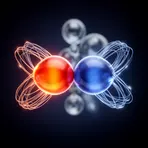
A pair of equal electric charges, one positive and one negative, close together like a water molecule
Compounds

- Specialized

 1
8.1
1
8.1
A measure of how far positive and negative charges are separated in a molecule

- Specialized
An antenna with two metal rods placed in a straight line with a connection in the middle

- Specialized
A molecule with one end always positive and the other always negative

- Specialized
Amount that shows how far positive and negative electric charges are separated, equal to charge size times distance

- Specialized
An object with two opposite poles, like a bar magnet, that makes a force around it
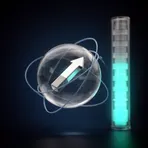
- Specialized
A number that shows how strongly and which way something acts like a tiny magnet
How Many Poles

Surface Forms
Morphology
Etymology
Dipole comes from the parts di- 'two' and pole 'end' or 'point', like in bicycle where di- means 'two'. So a dipole is literally 'two poles', which is why it describes a pair of opposite electric charges or magnetic poles separated by a short distance.