

contraction
 13
3.2
13
3.2

- noun
- /kənˈtrækʃən/
- 'Can't' is a common contraction used to represent 'cannot' in everyday conversation.
- braille contractions
- introduction of contractions
- use contractions
Loading YouTube…
Watch on YouTubeYou know, and it's like, well, the first name is a contraction of Michael Koch.
- You know, and it's like, well, the first name is a contraction of Michael Koch.
- It's a contraction of Prometheus and Theism.
Examples
-
"Ma'am" is a contraction for "madam."
-
Students who were introduced to more contractions early tended to do better on vocabulary and spelling.
Academic text (2009) -
You know, and it's like, well, the first name is a contraction of Michael Koch.
-
But the top spellers were all students who had learned many contractions early.
Academic text (2009) -
By the end of the third reader, all 189 braille contractions would have been introduced.
Academic text (2009) -
For example, there were 10 Grade 2 contractions that would increase space savings from 9.42% to 12.46%.
Academic text (2009) -
I taught myself Braille: the alphabet first, then the contractions and abbreviations.
Fiction book (1997) -
It's a contraction for 'do not', which becomes 'don't' in spoken English.
-
In English, a contraction often combines two words into one, like 'she'll' from 'she will.'
Compounds
- Specialized
3
3.4
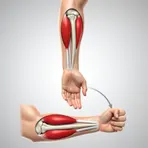
A muscle that becomes shorter or tighter and causes movement and tension

- Specialized
1
3.6
A strong tightening of the womb muscles that helps push a baby out during labor

- Specialized

 1
3.5
1
3.5
A short tightening of a muscle that makes it shorten or stiffen

- Specialized
1
7.3
A heartbeat that comes early so it feels like a skipped beat

- Specialized
A painless short tightening of the womb during pregnancy that does not mean labor
How Omitted

Surface Forms
Morphology
Etymology
Contraction for a shortened word comes from the same idea: parts are 'pulled together' into a smaller form, as when 'do not' becomes 'don't'. So a contraction joins words and makes them shorter.