

cone
 12
7.0
12
7.0

- noun
- /koʊn/
- Specialized
- Our eyes, we have those rods and cones in our eyes, right?
- rods and cones
- cone cell
- cone opsin
Loading YouTube…
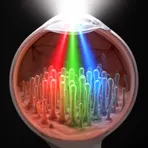
Watch on YouTubeWe call them red cones for simplicity, green cones and blue cones.
- We call them red cones for simplicity, green cones and blue cones.
- Because yellow light would trigger our red cone about right here at its peak, and our green cone somewhere in the middle of its peak luminosity.
- There are three types of specialized cells called cone cells.
Examples
-
Does it mean that the red, green, and blue cones are all firing at the same rate?
Blog text (28) -
First, the blue cones are outside the fovea, where the close-packed cones give the greatest resolution.
Blog text (7) -
See, retinas only have three types of cone cells, so maybe none has the signal strength to see it in our normal state.
-
However, our cones have a higher light threshold than our rods.
-
His eyes had changed from photopic, or cone, vision to scotopic, or rod, vision.
Academic text (1995) -
And that's because only one out of eight blue cones exist in the retina.
-
My vision uses a complex system of light, lenses, cones, rods, a visual cortex, and so forth.
Blog text (34) -
Retinitis pigmentosa is a rod-cone dystrophy, commonly genetic in nature.
Academic text (2004) -
Their tongues scooping up the ice cream rapidly melting in their cones, the twins studied the poster with interest.
Fiction book (1996) -
The three types of cones in our retinas allow us to see a wide range of colors in bright light.
Synonyms

 1
6.6
1
6.6
A cell in the eye that senses bright light and helps you see color

A cell at the back of the eye that sees color in bright light
Antonyms

Compounds


- Specialized
2
6.5
The pointed front part of a rocket, missile, or plane that protects important parts and reduces air resistance during flight
 1
2.3
1
2.3
A shape with a round base that narrows to a single point at the top like an ice cream cone


- Specialized
A tree from California with very large cones 4 to 8 inches long

- Specialized
A tree from California with very large cones four to eight inches long

- Specialized
A machine part with cone-shaped surfaces that use rubbing to let power pass between two shafts

- Specialized
A clutch with cone shaped friction surfaces that connects two rotating shafts




- Specialized
A wide fan of sand and stones that forms when a fast river slows at a mountain base


- Specialized
A small cone of clay that melts at a set temperature to show how hot a kiln is

- Specialized
A cone shape with the top cut off leaving two round ends of different sizes


How Light-Sensitive
- Specialized

- Specialized
12
7.0
Surface Forms
Etymology
Cone comes from Greek konos, meaning 'cone'. Some cells in the eye look like tiny cones, so they were called 'cones', and because of their shape these cone cells help us see colours in bright light.