
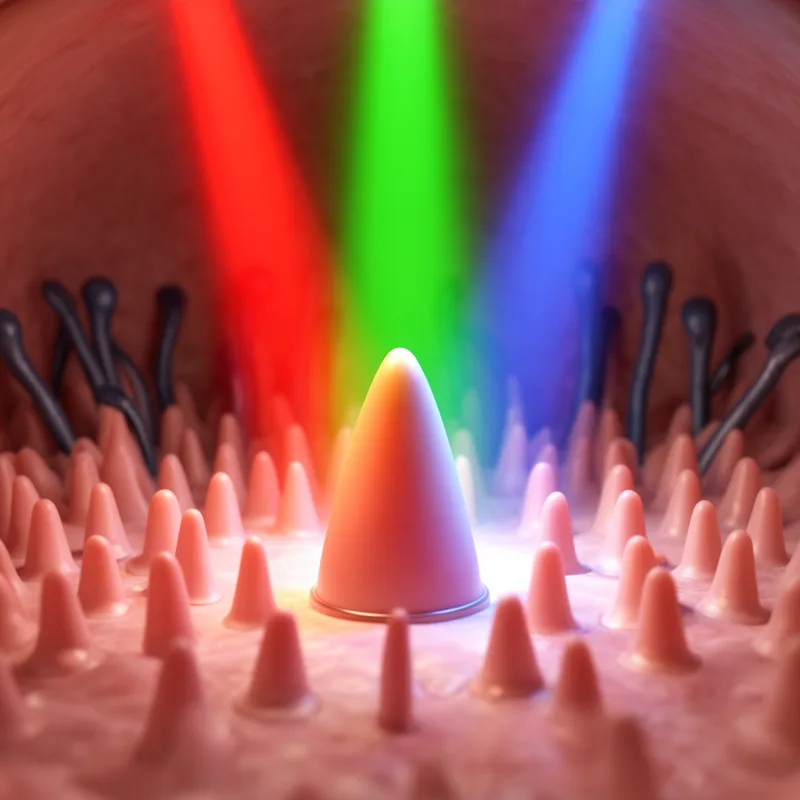
cone cell
- noun
- /koʊn sɛl/
- Specialized
- In humans, any given cone cell contains only one of three types of pigment; in other vertebrates, a single cone cell can hold multiple pigments.
Loading YouTube…
Watch on YouTubeThere are three types of specialized cells called cone cells.
- There are three types of specialized cells called cone cells.
Examples
-
When yellow light enters my eye, it stimulates my red and green sensitive cone cells, although not as much as pure red or green light would.
-
Instead, you have these cone cells at the back of your eyes that are sensitive to different parts of the spectrum.
-
See, retinas only have three types of cone cells, so maybe none has the signal strength to see it in our normal state.
-
There are no cone cells for white light, so what does the color "white" really mean physiologically?
Blog text (28) -
In humans, any given cone cell contains only one of three types of pigment; in other vertebrates, a single cone cell can hold multiple pigments.
Academic text (2009) -
But even that is vibrant luxury compared with the vision in creatures such as whales and seals, which have just one kind of visual pigment in their cone cells and see only shades of one color.
Academic text (2009) -
The cone cells in the retina are crucial for our ability to see bright colors in daylight.
-
When you are in bright sunlight, your cone cells help you perceive the vibrant colors around you.
-
Damage to the cone cells can lead to difficulties in seeing colors and bright lights.
Synonyms

 12
7.0
12
7.0

A cell in the eye that is sensitive to bright light and lets you see color

 1
6.6
1
6.6
A cell in the eye that senses bright light and helps you see color
Antonyms

How Light-Sensitive
- Specialized

- Specialized
Surface Forms
Morphology
The term is a straightforward noun-noun compound: 'cone' (a photoreceptor sensitive to bright light and color) + 'cell' (a biological unit) yields a cell that is a cone photoreceptor in the retina. Although somewhat technical, the meaning is directly compositional and mirrors equivalent literal compounds in many languages, so a learner who knows both constituents would readily infer the MWE's meaning.
Etymology
Cone cell is named for its shape: each light-sensing cell looks like a small cone, like a tiny ice-cream cone at the back of the eye. These cone-shaped cells work in 'bright light' and detect different colors of light, so they let us have 'color vision'.