

to close in
 119
4.6
119
4.6

- phrasal verb
- /kloʊz ɪn/
- The investigators were now closing in on the real killers.
Loading YouTube…
Watch on YouTubeThey fought at range with slings, bows, and javelins before closing in with Spears, swords, and clubs.
- They fought at range with slings, bows, and javelins before closing in with Spears, swords, and clubs.
- It starts to feel a little dizzy and the world slowly feels like it's closing in.
- But trust me when I tell you and listen very carefully to this, your world is closing in.
Examples
-
French forces are closing in from all directions.
-
When he comes to get the meat we drop the net and close in on him.
-
"They closed in upon me."
-
They've been closing in on us all night.
-
Lando saw that a small ship was closing in on his position.
Fiction book (1991) -
We're closing in on Eddie Boyd and his gang.
-
All their attention was strained to hear the men as they closed in on Damian.
Fiction book (1991) -
With night closing in, the Egyptians gave up the battle and retreated.
-
While the second guardian struggled to keep its balance, Worf closed in and grabbed its arms.
Fiction book (1992) -
The hunters closed in on the deer, making sure not to scare it away.
Synonyms
 ∞
1.7
∞
1.7
To be all around a person or thing on every side
 84
3.7
84
3.7
Surround something completely, often with a wall or fence
 63
3.9
63
3.9
Move nearer to someone or something, often to surround and catch them
 41
4.5
41
4.5
To surround something completely, like fog or darkness
 7
5.8
7
5.8
To build a barrier around something to keep people in or keep others out
 6
6.7
6
6.7
Surround a person or thing so they cannot leave
 1
4.3
1
4.3
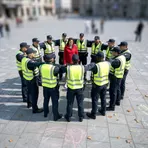
Move closer to surround something


 1
4.8
1
4.8
To move close together around a person or thing leaving little space

Surround something completely on all sides to shut it in

Surround something completely so it cannot get out or move
Antonyms

How Enclosed

Surface Forms
Morphology
The meaning 'to move closer from all sides to surround' is directly inferable from 'close' (to draw near) combined with the directional/inside sense of 'in', so a learner who knows both words can reconstruct the sense. This verb + particle composition is a common, cross-linguistically transparent motion pattern, making the expression immediately comprehensible to a B1 learner.
Etymology
Close in comes from the image of people or things moving close and coming in from all sides, like a circle getting smaller around someone. That's why it means 'to move closer from all sides' or 'to surround'.