
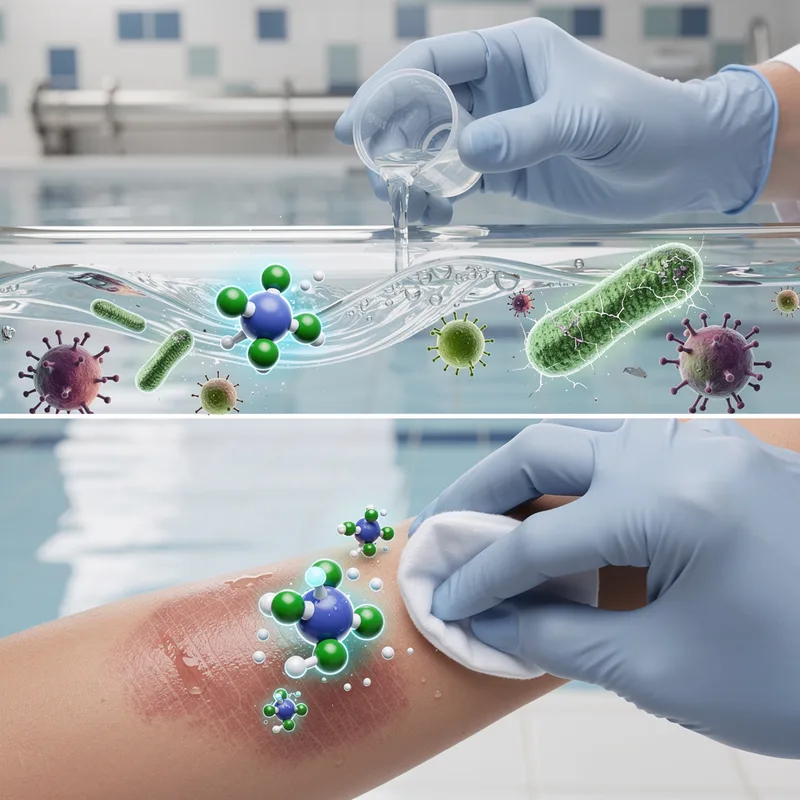
chloramine
 2
8.9
2
8.9

- noun
- /ˈklɔːrəˌmiːn/
- Specialized
- Many people are concerned about the effects of chloramine in their drinking water supply.
- chloramine level
- chloramine concentration
- chloramine dissipation
Loading YouTube…
Watch on YouTubeWe throw ammonia into the system and we create chloramines.
- We throw ammonia into the system and we create chloramines.
- Chlorine and chloramine are gases that cities will put in their water to to remove any harmful pathogens.
Examples
-
The water treatment facility uses chloramine to ensure the water is safe for drinking.
-
If utilities can obtain a high level of chloramine in the distribution, problems such as dissipation and THMs can be reduced.
Academic text (2003) -
Therefore, chloramine values obtained at each tap are different, and this compromises the results.
Academic text (1997) -
I live in the San Francisco Bay Area, and the SFPUC started using chloramine in February 2004.
Blog text (12) -
Blogfinger Poll: Have you experienced any medical issues as a result of the chloramine in your water?
Blog text (12) -
In many of these areas, citizens have reported adverse reactions to their chloramine-treated water.
Blog text (12) -
During a routine inspection of a new indoor swimming pool facility, extremely high levels of chloramines were found.
Academic text (1998) -
Despite numerous attempts, however, no shock treatment succeeded in eliminating the chloramines from the park district pools.
Academic text (1998) -
The plant's finished water contains chloramine at a concentration of 3.5–4.5 mg/L.
Academic text (1997) -
Disinfection of pathogens in the plant water is conducted by chloramine at the O.N. Stevens Plant located in the City of Corpus Christi.
Academic text (1997)
Synonyms
 1
8.4
1
8.4
A salt used to kill germs and bleach things

A chemical used to kill germs on skin and surfaces
Compounds
Surface Forms
Morphology
Etymology
The word chloramine comes from two parts: chloro- and -amine. Chloro- comes from a Greek word meaning 'green' and is the same start as chlorine, and -amine comes from ammonia, showing it has 'nitrogen' in it. So chloramine is a chemical that combines chlorine and nitrogen and is used to kill germs in water and on skin.