
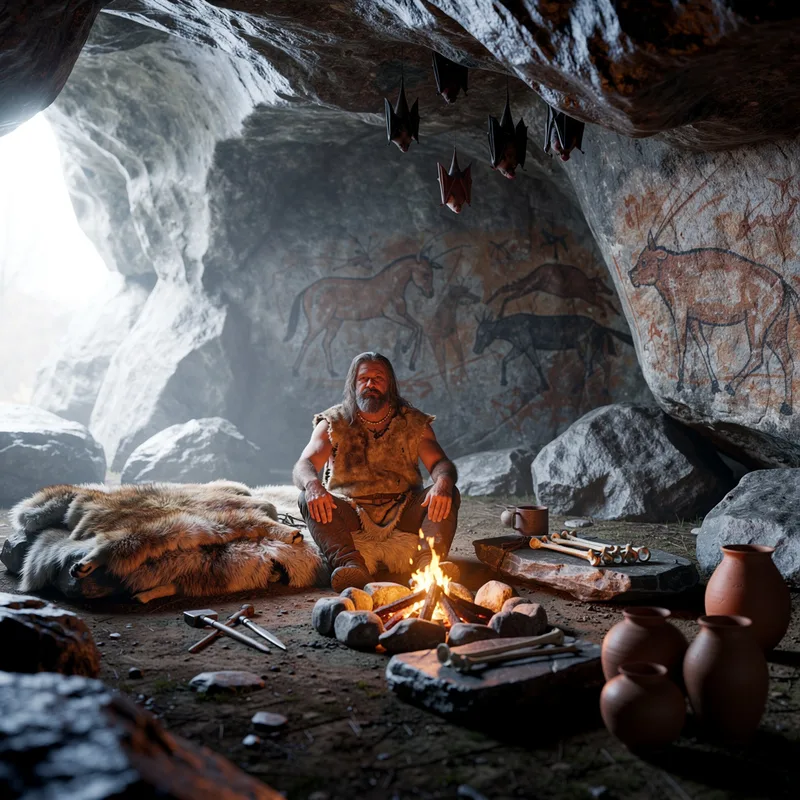
cave dweller
 1
6.0
1
6.0

- noun
- /keɪv ˈdwɛlər/
- Prehistoric cave dwellers relied on hunting and gathering for their survival.
Loading YouTube…
Watch on YouTubeOK, about a trillion seconds have passed since cave dwellers painted on cave walls.
- OK, about a trillion seconds have passed since cave dwellers painted on cave walls.
- Wouldn't they Then when they go back down to The Cave to tell all the other cave dwellers, wouldn't they seem crazy?
Examples
-
In the Stone Age, cave dwellers created paintings on the walls of their shelters.
-
The archaeologist discovered tools used by ancient cave dwellers in the region.
-
You, a cave dweller, are now walking amongst us.
-
OK, about a trillion seconds have passed since cave dwellers painted on cave walls.
-
And then you go from that to it's like the opposite species now you're like this cave dweller that lives underground.
-
Since the days of the first cave dwellers, humans—hairless, weak, and helpless save for cunning—have survived by joining together in groups, knowing, as so many other edible creatures have found, that there is protection in numbers.
Fiction book (1991)
Synonyms
 41
3.9
41
3.9
A person who lived in caves a long time ago
 9
9.9
9
9.9
A person who lives in a cave or who lives apart from others and is old-fashioned
 1
8.4
1
8.4
A woman from the Stone Age who often lived in caves
 1
4.3
1
4.3
A very early person who lived in caves long ago


 1
6.7
1
6.7
A woman from long ago who lived in caves and used simple tools
How Reclusive

Surface Forms
Morphology
The phrase is compositionally built from 'cave' (a subterranean chamber) + 'dweller' (resident), so learners will easily infer a literal meaning 'someone who lives in a cave'; the figurative sense 'a recluse or someone who avoids social contact' is a metaphorical extension of that literal image. Because the idiomatic, evaluative nuance (recluse/ socially withdrawn) requires recognizing the metaphorical use rather than strict composition, it is only partly predictable for a B1 learner.
Etymology
Cave dweller comes from the simple image of a person or animal living inside a cave for shelter. Long ago, early humans and animals actually lived in caves, so the phrase means 'a person or animal that lives in a cave', often from prehistoric times.