
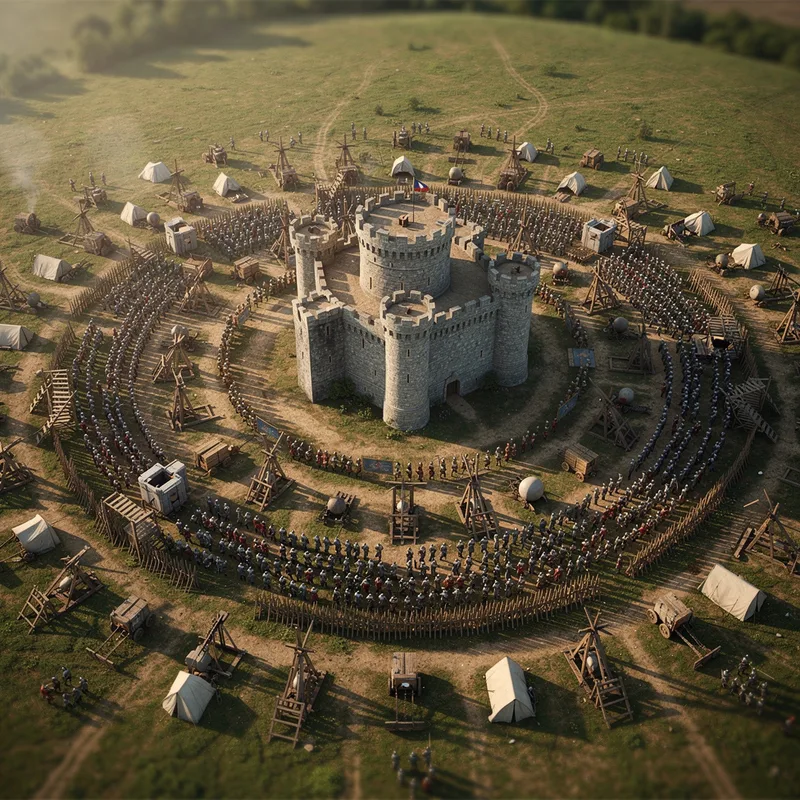
to besiege
 19
8.3
19
8.3

- verb
- /bɪˈsiːdʒ/
- During the conflict, the city was besieged by enemy troops, cutting off all supplies.
- besieged city
- besieged regime
- besieged government
Loading YouTube…
Watch on YouTubeOn the other hand, he does report that this Franks besieged Saragosa.
- On the other hand, he does report that this Franks besieged Saragosa.
Examples
-
Over the winter months, Agrippa besieged the town.
-
In the meantime, the War of Independence broke out and Jerusalem was besieged.
Fiction book (1993) -
My lord... we were besieged on all sides.
-
But on its return it is besieged by the rebel army
-
The crusaders had arrived at Jerusalem on 7 June and immediately began to besiege the city.
Academic text (1991) -
The next year, Victor besieged the Spanish port of Cadiz.
-
Imagine Quintus's surprise when, without warning, Ambiorix's army showed up and besieged his camp.
-
Around 300,000 people from Kobani, most of whom were Kurdish, took shelter in Turkey when ISIS besieged the city in September 2014.
Academic text (2017) -
Although the Albanians employed scorched earth tactics and continually attacked the Ottomans, Murad managed to besiege the important fortress of Svetigrad in May.
-
After surviving relentless attacks from mercenary forces in the escalating oil wars, sources tell us that pleas have finally been answered for the besieged employees of Yutime Chinese oil refinery in the Middle East.
Synonyms
 ∞
1.7
∞
1.7
To be all around a person or thing on every side
 7
8.2
7
8.2
Surround a place with soldiers and cut off its supplies to make it give up
 6
6.7
6
6.7
Surround a person or thing so they cannot leave
 3
9.5
3
9.5
To surround a place with soldiers to force it to give up
 1
8.2
1
8.2
To surround an enemy to make them give up
Antonyms


How Attacked
20
7.0
 19
8.3
∞
1.3
66
4.1
19
8.3
∞
1.3
66
4.1
- Formal
16
8.0
302
4.0
Surface Forms
Morphology
Etymology
Besiege comes from be- + siege, where siege originally meant 'seat', like the English word seat, and came to mean a camp set up around a town in war. So to besiege a place is to 'surround' it with soldiers to capture it.