

to beleaguer
 3
9.5
3
9.5

- verb
- /bɪˈliːɡər/
- Despite being beleaguered by enemy troops, the soldiers held their ground and refused to surrender.
Examples
-
In 1809, the king participated in no great procession through his war-beleaguered capital.
Academic text (1997) -
But Jean-Bertrand Aristide's government, beleaguered on all sides, was planning a world-class bamboche, hoping a wild party might change its fortunes.
Academic text (2004) -
But when funds get withdrawn from schools that fail, where will those already beleaguered schools turn?
Academic text (2005) -
I can't tell you how many times I heard the word 'beleaguered' next to 'Apple.'
Blog text (32) -
This decision created an unnecessary breach with Jerusalem that served to isolate an already beleaguered Israel even further.
Academic text (2009) -
The middle class is feeling beleaguered: it does not want to have to move down the skill ladder, but its upward prospects are increasingly limited by competition from China and India.
Academic text (2011) -
Two miles to the southwest, Oisc "Big Knife" and his Kentish men were camped about beleaguered Badon town.
Blog text (15) -
One feature of denialism is the tendency to think of the denialist position as beleaguered, under attack, and in a minority that has to stave off the assaults of the vast wrong-thinking majority.
Blog text (29) -
As the first hypermodern pop music star, Lady Gaga's brand of celebrity emerges during a period beleaguered by recession and war, a time that yearns for the occasional glimpse of the sublime.
Academic text (2013) -
The enemy forces began to beleaguer the town, cutting off all escape routes for the inhabitants.
Synonyms
 ∞
1.7
∞
1.7
To be all around a person or thing on every side
 19
8.3
19
8.3
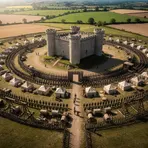
To surround a place with soldiers until the people inside give up
 7
8.2
7
8.2
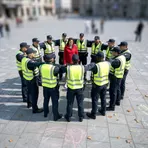
Surround a place with soldiers and cut off its supplies to make it give up
 6
6.7
6
6.7
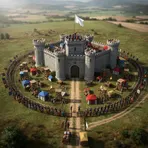
Surround a person or thing so they cannot leave
 1
8.2
1
8.2
To surround an enemy to make them give up
Antonyms

How Surrounded

Surface Forms
Morphology
beleaguer = be + leaguer
Although historically analysable as be- + a root meaning 'camp/host', the root 'leaguer' is not a productive or recognizable English base for learners, so the meaning 'besiege' cannot be derived transparently.
Etymology
Beleaguer comes from an old Dutch word made of be- and leger, where leger means 'camp' (like the German Lager). It originally meant to 'surround with an army', so to beleaguer a place is to put soldiers all around it to force it to surrender.