

banded anteater
- noun
- Australian
- The banded anteater uses its long tongue to extract termites from narrow tunnels.
Examples
-
Due to habitat loss, the banded anteater is now classified as a nearly extinct species.
-
Conservationists are working to protect the habitats of the endangered banded anteater.
-
Unlike true anteaters, the banded anteater is a marsupial native to Western Australia.
-
The banded anteater is a unique marsupial.
-
Have you ever seen a banded anteater?
-
The banded anteater is known for its specialized diet, primarily consisting of termites.
-
In Australia, conservation efforts are focused on preserving the banded anteater and its environment.
Synonyms

A small Australian animal with a pouch, long snout, and strong claws that eats termites
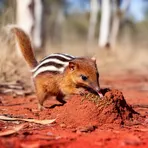
A small Australian animal with a long nose that eats termites
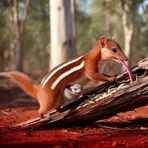
A small Australian animal with a pouch that eats termites and has stripes
Surface Forms
Morphology
The noun phrase is directly compositional: 'banded' (marked with bands) modifies 'anteater' (an animal that eats ants/termites), so a learner who knows both words will infer an anteater with bands. While finer biological facts (marsupial status, conservation) are not recoverable from the words, the core referent is transparently derived by standard adjective+noun composition and is cross-linguistically obvious.
Etymology
The name banded anteater comes from how the animal looks: it has dark bands on its back and a long snout like an anteater for reaching termites. That's why the name points to this small Australian 'marsupial' that eats insects.

