
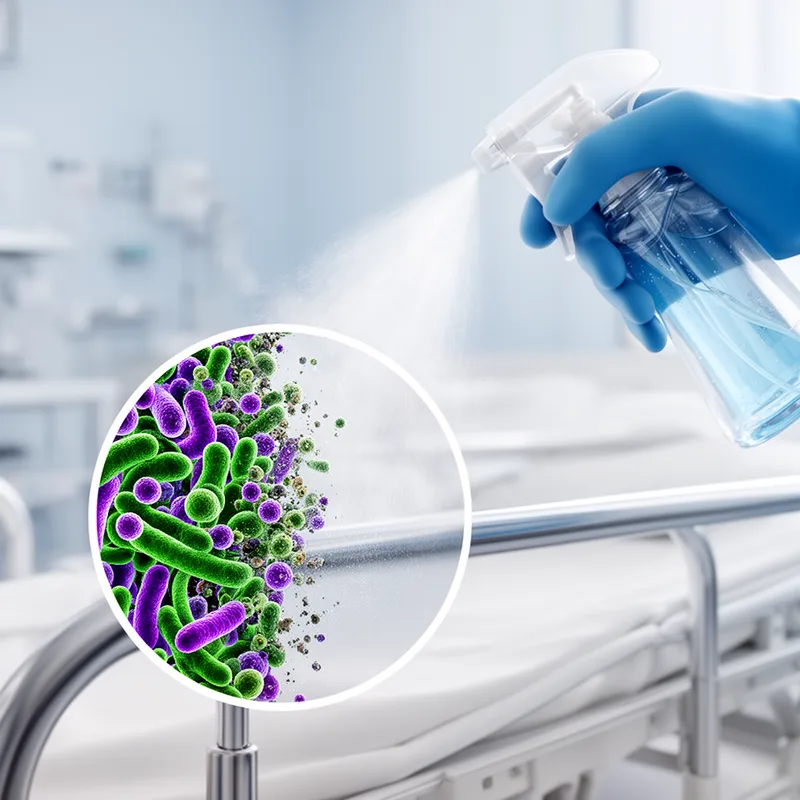
bactericidal
- adjective
- /bækˌtɛrɪˈsaɪdəl/
- Specialized
- To prevent infections, it is important to use a bactericidal treatment for wounds.
- bactericidal activity
- bactericidal effect
- bactericidal agent
Loading YouTube…
Watch on YouTubeAcute high blood sugar decreases your neutrophils chemotaxis, phagocytosis and bactericidal capacity.
- Acute high blood sugar decreases your neutrophils chemotaxis, phagocytosis and bactericidal capacity.
Examples
-
No difference in serum bactericidal activity against Hib between Aboriginal and non-Aboriginal CRF patients was found.
Academic text (2015) -
The addition of chlorhexidine to alcohol is known to intensify its bactericidal effects (Elston, 2007).
Academic text (2010) -
Silver is chosen because it is known to be a solid bactericidal agent.
Academic text (2011) -
When bactericidal agents such as hypochlorites and QAC are being considered, various factors should be taken into account.
Academic text (2005) -
Its bactericidal potential can be easily demonstrated by studying the killing effect of chlorinated water on E. coli.
Academic text (1997) -
Chemical sanitizers are destroyed by food debris, and there is no means of determining when the bactericidal action of the sanitizer has been exhausted.
Academic text (2005) -
Our results indicate that Aboriginal adults possess substantial serum bactericidal activity against Hia, which is mostly due to IgM antibodies.
Academic text (2015) -
Acra and colleagues' studies 2-4 of Escherichia coli showed that this bactericidal effect was due mainly to the long-wave ultraviolet component of sunlight.
Academic text (1996) -
The new disinfectant is highly effective and has strong bactericidal properties against harmful germs.
-
The research showed that the solution had a significant bactericidal effect on several strains of bacteria.
Synonyms

 12
4.9
12
4.9

Free from germs and able to kill them
 3
5.1
3
5.1
That kills or stops the growth of germs that cause disease


 1
8.4
1
8.4
Stopping bacteria from growing or making more without killing them

Causing bacteria to break open and die

Able to kill germs or stop them from growing

Able to kill germs like bacteria and viruses

Able to kill germs and stop their growth

Able to kill harmful living things such as bacteria or insects
Antonyms
How Antimicrobial
- Specialized
3
4.5

- Specialized
- Specialized
3
5.1
- Specialized
3
3.7
3
2.7
Surface Forms
Morphology
bactericidal = bactericide (semi-transparent) = bacteri + cidal
The adjective is transparently formed from the noun 'bactericide' with the standard adjectival suffix '-al'.
Etymology
Bactericidal breaks into bacteri- from 'bacteria' meaning 'tiny living things' and -cidal meaning 'killing', as in pesticide. So, bactericidal means 'killing bacteria'.