
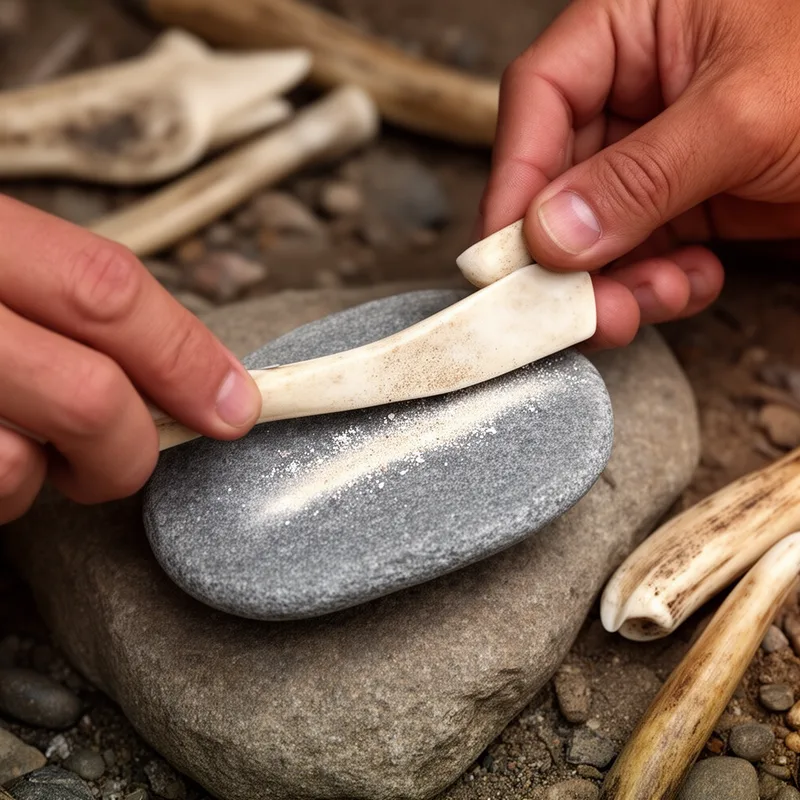
abrading stone
- noun
- Specialized
- She used an abrading stone to sharpen her knives before the big cooking competition.
Examples
-
Archaeologists uncovered an abrading stone in the excavation, indicating that early humans had tools for grinding.
-
Although the site has yielded small blades, flakes, and abrading stones that clearly lie below the Clovis layer, questions about some of the Clovis dates have led critics to question the dating of earlier artifacts as well.
Academic text (2006) -
The ancient craftsman skillfully used the abrading stone to smooth the edges of the wooden tool.
Synonyms

 9
6.9
9
6.9

A thick round stone that turns to sharpen knives and other tools
 2
5.7
2
5.7
A material used to grind or polish surfaces by rubbing

A stone used with oil to sharpen the edge of knives and tools

Something that wears down or smooths a surface by rubbing

A hard thing like sandpaper or diamond that wears down and smooths surfaces
How Abrasive

Surface Forms
Morphology
The noun phrase is directly compositional: 'abrading' (removing material by scraping) + 'stone' yields a stone used for abrading, so a learner who knows both constituents can infer it denotes a tool for grinding/smoothing. The gerundive modifier + noun pattern meaning 'tool used for X' is common cross-linguistically, reinforcing predictability for a B1 learner.
Etymology
Abrading stone is the name for a simple tool made from a rock that people rub on other things. The word abrading means rubbing away and stone is the rock, so picturing someone rubbing a rock on wood or bone helps you remember it was used 'to grind', 'to smooth', or 'to sharpen'.