
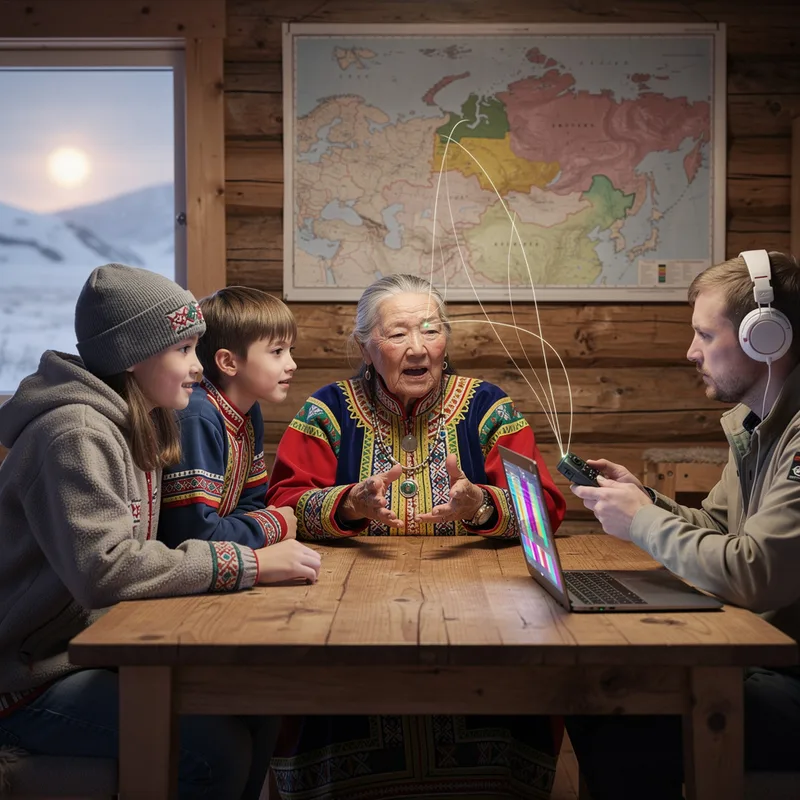
Same language
 1
9.9
1
9.9

- noun
- As we gathered in the village, it was clear that all the Sámi communicated in the same language passed down through generations.
- speak the Same language
Examples
-
The Sámi people in northern Scandinavia speak their traditional language, which is a unique example of the same language spoken by their ancestors.
-
During the cultural festival, many visitors were amazed to hear the same language that the Sámi use in their everyday lives.
-
I wished I knew her better, that we spoke the same language.
Fiction book (1990) -
"We don't talk the same language at all in this house.
Fiction book (1990) -
But we don't speak the same language.
Fiction book (1990) -
They spoke the same language!
Fiction book (1990) -
But the democratic way is to settle those conflicts by discussion, and that process is facilitated when the citizens speak, literally, the same language.
Academic text (1990) -
Even among themselves, slices of difference interpose, speaking the same language though they do, lacking feathers, and all drinking right side up.
Fiction book (1990) -
The same language, with minor variations, was later incorporated into the Balfour Declaration and the British Mandate over Palestine.
Academic text (1990) -
How instead might recognitions forge a social bond between people who may be necessarily hostile to one another, or who do not talk the same language, or can't understand one another though they use the same words, or simply have a right to silence?
Academic text (1990)
Synonyms


 1
9.8
1
9.8
A northern European language spoken by the Saami people in Norway, Sweden, Finland, and Russia
 1
9.9
1
9.9
The language spoken by Sami people in northern Scandinavia and northwest Russia

The language spoken by the native people of northern Scandinavia and parts of Russia

A language spoken by the native people of northern Scandinavia and Russia

A language spoken by the Sami people in northern Scandinavia

A group of related languages spoken by the Sami people in northern Norway, Sweden, Finland, and Russia

A group of related languages spoken by the Sami people in northern Scandinavia and northwest Russia

A language spoken by the Sámi people in northern Europe
Languages spoken by the Sámi people in northern Scandinavia, Finland, and Russia
A language spoken by the Sami people in northern Scandinavia and the Kola Peninsula

A language spoken by the Sámi people in northern Scandinavia, now usually called Sámi
Surface Forms
Morphology
This is a simple, compositional noun phrase: the proper-name element 'Same' (here denoting the Sámi people/language) combined with 'language' yields 'the language of the Sámi people'. Naming languages by proper noun + 'language' is a common and predictable pattern cross-linguistically, so a B1 learner who knows both constituents would readily infer the meaning.
Etymology
Same language comes from the name of the people called 'Sámi', who live in northern Scandinavia and the Kola Peninsula. So Same and language together mean 'the language of the Sámi people', which is why we use this name today.