

Pinus thunbergii
- noun
- Specialized
- Horticulturists recommend Pinus thunbergii for coastal gardens due to its tolerance of salt spray.
Examples
-
A healthy Pinus thunbergii can provide shade and beauty for decades in public parks.
-
The landscaping featured several mature Pinus thunbergii near the entrance for a striking effect.
-
The Pinus thunbergii is often used in Japanese gardens.
-
Many landscapers prefer Pinus thunbergii for coastal areas.
-
Horticulturists recommend Pinus thunbergii for coastal gardens due to its tolerance of salt spray.
-
A healthy Pinus thunbergii can provide shade and beauty for decades in public parks.
-
The landscaping featured several mature Pinus thunbergii near the entrance for a striking effect.
Synonyms
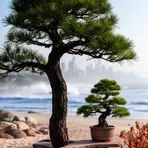
A Japanese pine with long needles in pairs often grown in gardens and for bonsai that resists salt and pollution

A large Japanese pine with two long needles that tolerates salty air and city pollution
Surface Forms
Morphology
Pinus + thunbergii
The binomial form signals that this is a species of pine: a learner who knows 'Pinus' (the pine genus) can infer it names a type of pine. However, 'thunbergii' is a Latinized specific epithet (a proper-name derivation) that does not convey the common name or the species' properties to an average B1 learner, so the full, specific meaning is not predictable.
Etymology
Pinus thunbergii comes from two parts: Pinus meaning the pine group and thunbergii, which means 'of Thunberg' because it was named after a scientist who collected plants in Japan. So the name points to the 'Japanese black pine', the pine often used in gardens and known for its strength against salt and pollution.

