
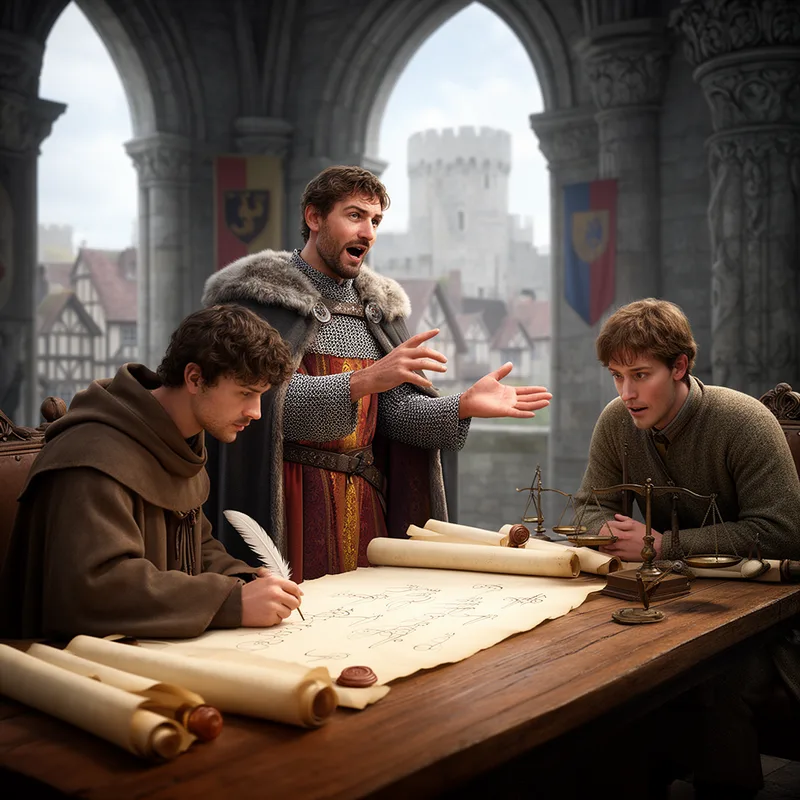
Norman French
- noun
- /ˈnɔrmən frɛntʃ/
- Archaic
- Under its new Norman French overlords, the Kingdom of England would seek to accomplish what the Anglo-Saxon kings never had, the total conquest of the Celtic Britains.
Examples
-
During the book, Lynn has Emma (rightly) trying to make out the Saxon English and Norman French.
Blog text (9) -
At one point, a char says both please and pray, but likely in Saxon, 11th-century English, before Norman French had merged into it to begin Middle English, Anglo-Norman.
Blog text (9) -
"We have our blunt Anglo-Saxon epithets and our precise Norman-French euphemisms, and the habit of hospitality, the openness to loan words from many languages, continues to enrich English to this day.
Blog text (4) -
Norman French became a dominant language among the English nobility after the Norman French Conquest.
-
Many legal terms in English derive from Norman French, reflecting its influence on the legal system.
-
The blending of old English with Norman French led to the rich vocabulary we have today.
Synonyms

A form of Old French spoken in Normandy in the Middle Ages that influenced English law and words
A form of Norman French used in England in the Middle Ages by rulers, courts, and writers
A form of Norman French used in England from the 11th to the 15th centuries
A form of French used for law and government in England in the Middle Ages

The French spoken in England in the Middle Ages by rulers and lawyers

A form of French spoken in northern France in the Middle Ages
Surface Forms
Morphology
The noun phrase is a straightforward composition: 'Norman' (connected with Normandy) modifies 'French' (the language), so a learner who knows both words can infer it refers to the variety of French associated with the Normans. This kind of modifier+noun construction is cross-linguistically common and therefore immediately comprehensible to a B1 learner familiar with the constituents.
Etymology
Norman French comes from the Normans, people from Normandy who spoke a form of French and took control of England in 1066. Because they ran the courts and government, many official and legal words from their speech entered English, so today Norman French means that old kind of French and the way it changed English.

