

Marathon
 50
7.1
50
7.1

- proper noun
- /ˈmɛrəˌθɑn/
- The Athenians achieved a remarkable victory at Marathon against the much larger Persian army.
- battle of Marathon
- Marathon and Salamis
Loading YouTube…
Watch on YouTubeSo he says, you know, think about, and he's bringing a battlefield courage marathon, Salimus Plataea, Thermopylae, right.
- So he says, you know, think about, and he's bringing a battlefield courage marathon, Salimus Plataea, Thermopylae, right.
- And so the idea is to to OK, but we're all going to be like the dude who ran from marathon to Athens and to report on the battle and then just drop dead.
Examples
-
The historical significance of Marathon is evident as it marked a turning point in the Greco-Persian Wars.
-
A massive excavation project connected to preparations for the rowing site on the plain of Marathon sparked controversy among archaeologists, historians, and environmentalists.
Academic text (2004) -
Then the Persians landed at Marathon to mete out the same punishment to Athens.
-
Miltiades sent Pheidippides, a runner, from Marathon to Athens with news of the victory (Balcer, 2009).
Academic text (2013) -
In 490 BC, the famous battle of Marathon showcased the bravery of the Athenian soldiers.
Synonyms
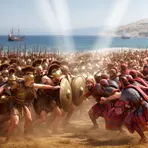
A fight in 490 BC near Marathon, Greece in which the Athenians defeat Persian invaders
Compounds

 4
1.8
4
1.8
A time when people watch several movies one after another without long breaks
A fight in 490 BC near Marathon, Greece in which the Athenians defeat Persian invaders


Surface Forms
Etymology
The word Marathon is the name of a place in Greece; its old Greek name Marathon meant 'fennel', a plant that grew there. A famous battle was fought at Marathon in 490 BC, and a later story about a runner from that battle is why a very long race is also called a 'marathon'.