
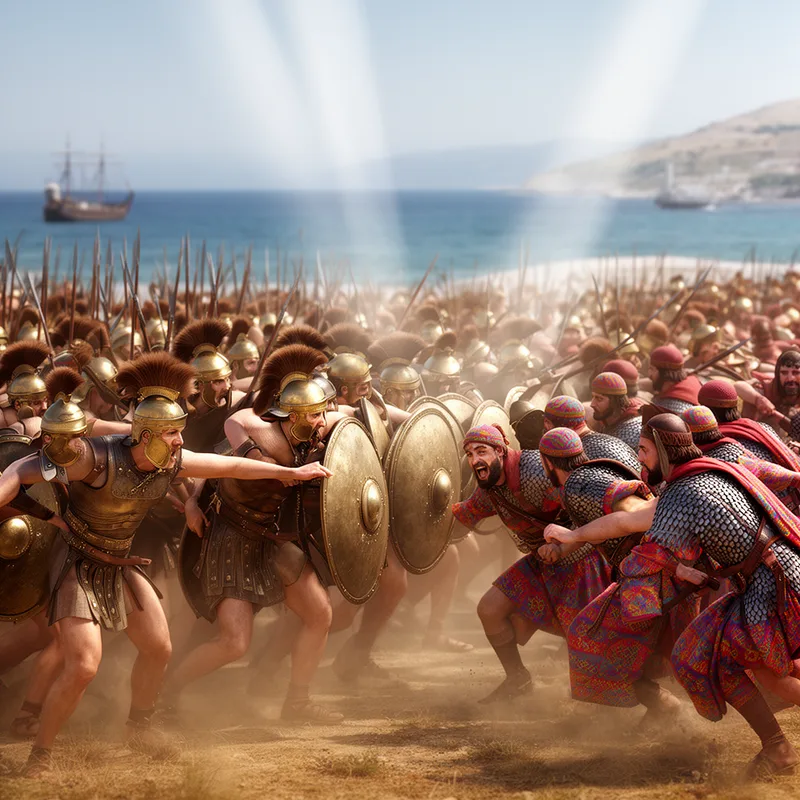
battle of Marathon
- noun
- /ˈbætəl əv ˈmærəˌθɒn/
- In 490 BC, the battle of Marathon marked a pivotal moment in Greek history as the Athenians triumphed over invading forces.
Examples
-
The Athenians secured a historic victory at the battle of Marathon against the Persians in 490 BC.
-
Many argued that the site was the location of the famous battle of Marathon ("Olympic Battle," July/August 2001) and should not be spoiled with construction.
Academic text (2004) -
The battle of Marathon is celebrated every year, commemorating the bravery of the Athenian soldiers who fought against Persia.
Synonyms
 50
7.1
50
7.1

A battle in 490 BC near Marathon, Greece, where Athenians with fewer soldiers defeat the Persian army
Surface Forms
Morphology
The phrase is compositionally built from 'battle' (a large fight) + 'of' (linking) + 'Marathon' (place/name), so a B1 learner who knows those constituents will infer it refers to a battle that took place at Marathon. Although specific historical details (date, belligerents) are not deducible from the words alone, the core locative event meaning is directly predictable and follows common cross-linguistic patterns.
Etymology
The battle of Marathon was fought in 490 BC on the plain of Marathon, where Athenian soldiers defeated the Persian army. One popular story says a messenger ran from the battlefield to Athens to bring the news, and that long run inspired the modern 'marathon race'. So, today the name remembers both the famous fight and the idea of a long run.