

Greek
 148
1.0
148
1.0

- noun
- /ɡrik/
- As a Greek, she takes pride in her country's rich history and traditions.
- ancient Greeks
- Greeks and Romans
- Greeks and Armenians
Loading YouTube…
Watch on YouTubeThat's just how they go back to the Greeks, Medea, Oedipus.
- That's just how they go back to the Greeks, Medea, Oedipus.
- Wilson, frustrated with the Italians, suggested the Greeks land sooner rather than later.
- I am not an Athenian or a Greek, but a citizen of the world.
- We have Greeks talking about Egypt, right?
- So anyway, it's the Greeks like this sort of thing.
- And the name that the Greeks gave it translated to Milky Circle.
- He is Greek, he's a Greek man or child was a child.
- Well, what he calls with the Greeks called flattery.
- The Greeks, what are the Greeks themselves say in their own text?
- And in fact, another Speaking of Greek, a French Greek, Georges Moustaki.
Examples
-
The European bureaucrats demanded the Greeks reduce their debt without offering reforms to encourage growth.
Academic text (2011) -
You know, the Greeks didn't write obituaries.
-
If a Greek can do it, we can do it.
-
One French, one Greek, and one of unknown origin.
-
Some of my best friends, they are Greeks, like my father.
-
I am not an Athenian or a Greek, but a citizen of the world.
-
Money is an innovation recently introduced by the Greeks.
-
Although they won the first battle of Himera, the Greeks would not have the upper hand forever.
Academic text (2011) -
Beginning with the investigations of the Greeks, historians wrote of past glories.
Academic text (1990) -
Eros to the Greeks, Cupid or Amor to the Romans.
Synonyms


Idioms

Compounds







- Literature
1
7.4
A group of people in ancient Greek plays who comment on the action for the audience
 1
9.9
1
9.9
A form of Ancient Greek spoken and written in Athens to create famous plays and philosophy around 400 BC

 1
4.1
1
4.1
The main Christian church in Greece that follows the Eastern Orthodox tradition


- Specialized
A form of Greek spoken and written in the Byzantine Empire from about 600 to 1200


- Specialized
A form of Greek used in speech and writing from the 3rd to the 8th centuries AD


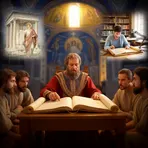
A form of Greek spoken and written from about 600 to 1200 AD between Ancient and Modern Greek



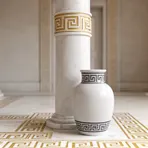
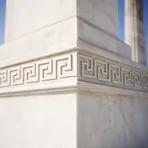
A repeating design of vertical and horizontal lines that people use to decorate buildings and objects


- Specialized
A musical scale with a fixed pattern of notes used in ancient Greek music

A style of building from ancient Greece using columns, symmetry and decorations

A plant that lives for one year with pale flowers and fragrant seeds used in cooking and medicine

A cross with four arms that are the same length used in Christian art and church buildings


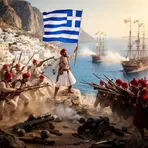
A war from 1821 to 1829 when Greeks fought Turkish rule to create an independent Greek state

The Greek language spoken and written from the Middle Ages to today, also called Modern Greek


A war from 1821 to 1829 in which Greeks fight to become independent from Ottoman rule
Surface Forms
Etymology
Greek comes from the Latin Graecus, the name the Romans used for people from Hellas ('Greece'). So a Greek is a person who comes from or belongs to Greece.