
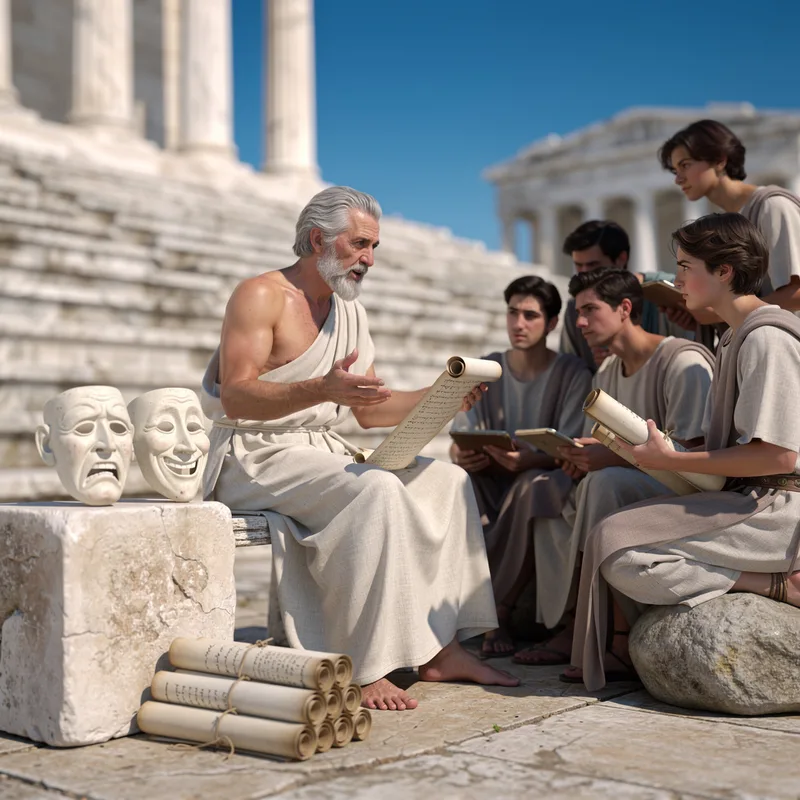
Classical Greek
 1
9.9
1
9.9

- noun
- /ˈklæsɪkəl ɡrik/
- Among the Byzantine scholars in attendance was Gemistos Plethon, a theologian and classical Greek scholar.
- Classical Greek and Roman
- Classical Greek vase
- Classical Greek style
Loading YouTube…
Watch on YouTubeThose people don't read classical Greek.
- Those people don't read classical Greek.
- I remember the very first day of the very first class in ancient Greek, classical Greek that I was taking.
- And they offered classes in classical Greek where I went to a Graduate School at Southern Illinois University in the classics department.
Examples
-
A classical Greek example of the latter type is "What is the strongest of all things?"
Blog text (20) -
Translation from the classical Greek is totally weird, right?
Blog text (13) -
I remember the very first day of the very first class in ancient Greek, classical Greek that I was taking.
-
I did in fact learn classical Greek and I, I learned it in part so I could read people like Plato.
-
Here is the "glory that was Greece" from a classical Greek perspective.
Academic text (1994) -
For Americans, that common culture is found, first of all, in Western civilization and its primary historical constituents: Judeo-Christianity and classical Greek philosophy.
Academic text (1991) -
It is not surprising that the word pharmakon in classical Greek means both poison and antidote, sickness and cure.
Academic text (1993) -
More significantly, like the classical Greek tragedies before it, Amno'n challenges the belief in a harmonious and comprehensible universe.
Academic text (1990) -
The middle and high schools in Greece have delicious names from Classical Greek—like Athena, Apollo, Olympia, and Odyssey Academy.
Blog text (3) -
I enrolled in a course to learn Classical Greek so that I could read the works of ancient philosophers.
Synonyms
 7
9.9
7
9.9
A form of ancient Greek spoken in Athens and nearby areas
How Old
5
9.9
 1
9.9
1
9.9
- Specialized
1
4.5
Surface Forms
Morphology
This is a straightforward adjective+noun composition: 'classical' (pertaining to antiquity) modifies 'Greek' (the language), so a learner who knows both constituents can infer it refers to the ancient/formal form of the Greek language. The construction is a regular, cross-linguistically common way to name historical language varieties, so the meaning is transparent to B1 learners.
Etymology
Classical Greek gets its name because this was the model form of Greek used in and around Athens when famous writers like Plato and Aristotle wrote, about 2,400 years ago. So, think of those great books to remember that Classical Greek means the old, standard written Greek from that time.