

Greek valerian
- noun
- UK
- We planted Greek valerian along the garden path for its striking blue flowers.
Examples
-
I planted Greek valerian in my garden last year.
-
The Greek valerian blooms beautifully in spring.
-
Gardeners appreciate Greek valerian for its attractive foliage and ease of care.
-
The delicate blooms of Greek valerian appear in late spring and last into early summer.
-
Gardeners appreciate Greek valerian for its attractive foliage and ease of care.
-
The delicate blooms of Greek valerian appear in late spring and last into early summer.
-
We planted Greek valerian along the garden path for its striking blue flowers.
Synonyms
 32
8.2
32
8.2

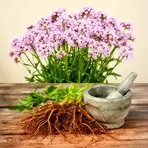
A plant with small white or pink flowers and roots used as medicine

A tall plant with sweet-smelling pink or white flowers and roots used in medicine

A tall plant that lives for many years with fragrant flowers and roots used to help people sleep

A tall plant with strong-smelling flowers whose roots are used to help people sleep

A group of plants that live for many years and are used in herbal medicine
Surface Forms
Morphology
The phrase is a straightforward adjective + noun combination where 'Greek' specifies the origin or variety of 'valerian.' A B1 learner who knows both words can reliably infer it refers to a type of valerian associated with Greece, following common compositional patterns found across languages.
Etymology
Greek valerian gets its name from the old plant name valerian, which comes from a word meaning 'to be strong' because people used the plant for a long time as a medicine to calm or help the body. The word 'Greek' was added for the kind that came from Greece, so the name reminds us of its old use as a medicine even though today we often grow it for its pretty flowers.