
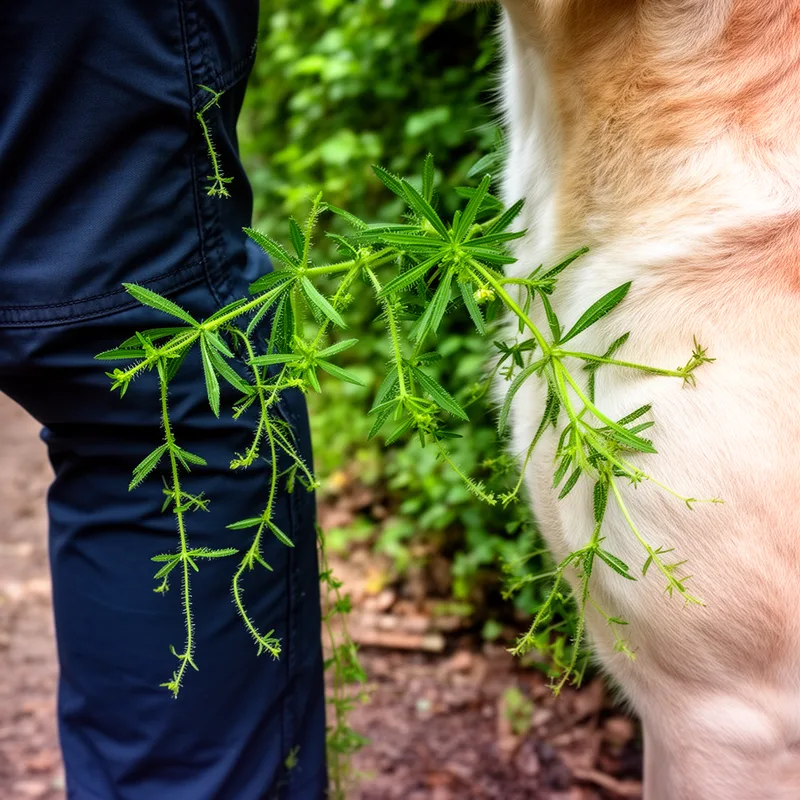
Galium aparine
- noun
- Specialized
- The tiny hooked hairs on the stems of Galium aparine help it cling to clothing and animal fur.
Examples
-
Farmers consider Galium aparine a weed because it can smother young crops.
-
Galium aparine is often found growing in hedgerows and along woodland edges.
-
I found some Galium aparine growing in my backyard.
-
Have you ever seen Galium aparine in the wild?
-
Galium aparine, commonly known as cleavers, often grows in dense patches near streams and rivers.
-
The stems of Galium aparine are covered in small prickles, which help the plant climb over other vegetation.
-
Many people use Galium aparine in herbal remedies due to its traditional medicinal properties.
Synonyms
A small climbing plant with thin stems covered in tiny hooked hairs that stick to clothes and fur

An annual plant with sticky, prickly stems that cling to clothes
A plant with rough stems and many small hooks that cling to clothes and animals

A plant with many hooked hairs on its stems that cling to clothes and animals

A small plant with curved prickly stems that stick to clothes and animal fur
Surface Forms
Morphology
Galium + aparine
This is a scientific Latin binomial (taxonomic name) rather than a compositional English phrase; its meaning ('cleavers' / 'goosegrass') is a conventional species label not derivable from the constituent forms. One constituent ('aparine') is not an English lexical item and 'Galium' is a genus name, so a B1 learner who knows the parts would not be able to infer the plant meaning without botanical or lexical knowledge.
Etymology
Galium aparine is a plant often called cleavers because its stems have tiny hooked hairs. Those hooks make the plant 'stick' to clothes and animal fur, so the name helps you remember it as the weed that 'clings'.

