

European chestnut
- noun
- /ˌjʊərəˈpiːən ˈʧɛstnət/
- UK
- The European chestnut is prized for its sweet, edible nuts, which are harvested in autumn.
Examples
-
Timber from the European chestnut has been used in furniture making for centuries.
-
Several ancient European chestnut trees still grow in the forests of southern France.
-
The European chestnut tree can grow up to 30 meters tall.
-
Many European chestnuts thrive in the Mediterranean climate.
-
The European chestnut is valued not only for its delicious nuts but also for its strong timber.
-
In the autumn, the European chestnut trees in the park are filled with people gathering the edible nuts.
-
The majestic European chestnut tree is an important part of the ecosystem in southern Europe.
Synonyms

 3
2.3
3
2.3

A large tree that makes nuts you can eat in prickly cases and has leaves that turn brown in autumn
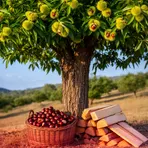
A tree that makes sweet, edible nuts and useful wood

A large tree that loses its leaves and makes nuts you can eat and good wood

A large tree that has sweet edible nuts and gives shade
How Big

Surface Forms
Morphology
The phrase is a straightforward noun phrase that combines 'European' (of or from Europe) with 'chestnut' (a deciduous tree with edible nuts), so the meaning — a chestnut species from Europe — is directly derivable from the parts. This compositional, descriptive pattern is cross-linguistically common and would be immediately understandable to a B1 learner who knows both constituents.
Etymology
European chestnut is the name for the chestnut tree that grows in Europe; imagine people picking sweet nuts from a big tree each autumn. The words European (where it grows) and chestnut (the nut it gives) explain why it means 'a large tree with edible nuts and useful wood'.