
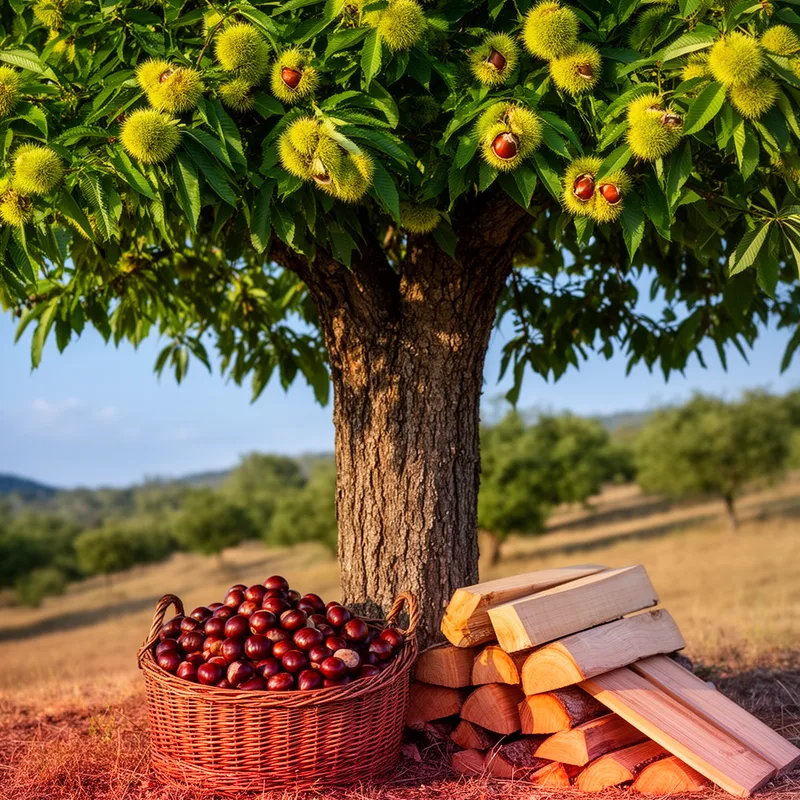
Castanea sativa
- noun
- Specialized
- Edible nuts from Castanea sativa are a traditional food in many Mediterranean countries.
Examples
-
Researchers studied the spread of Castanea sativa across southern Europe.
-
The Castanea sativa tree can grow up to 30 meters tall.
-
The ancient Castanea sativa in the village is over five hundred years old.
-
Many gardeners prefer Castanea sativa for its delicious nuts.
-
Edible nuts from Castanea sativa are a traditional food in many Mediterranean countries.
-
The ancient Castanea sativa in the village is over five hundred years old.
-
Many gardeners prefer Castanea sativa for its delicious nuts.
Synonyms

A large tree that loses its leaves and makes nuts you can eat and good wood
A large tree that loses its leaves and produces sweet edible nuts and useful wood

A large tree that has sweet edible nuts and gives shade
Surface Forms
Morphology
This is a Linnaean binomial combining the genus name 'Castanea' (a group of chestnut trees) with the species epithet 'sativa' (meaning cultivated). A learner who knows both constituents can infer it denotes a cultivated species of Castanea (i.e., a chestnut tree), so the meaning is directly derivable from the parts. The taxonomic naming pattern is systematic and cross-linguistically recognizable, supporting transparency.
Etymology
Castanea sativa comes from an old Greek word for the chestnut and the Latin word sativa, which means 'planted' or 'cultivated'. So the name literally means 'the cultivated chestnut', which explains why it refers to the sweet chestnut tree people grow for its edible nuts and wood.

