

European black alder
- noun
- The European black alder is commonly found near rivers and wetlands throughout the continent.
Examples
-
Wood from the European black alder is valued for its resistance to decay in water.
-
Her research focused on the growth patterns of European black alder saplings in restored marshlands.
-
The European black alder grows near rivers.
-
Many European black alders line the park's pathway.
-
The European black alder provides important habitat for various wildlife species in wetlands.
-
In many European countries, the European black alder is used for flood control and soil stabilization.
-
The characteristic dark bark of the European black alder makes it easy to identify in forests.
Synonyms

A medium-sized tree with dark bark and rounded leaves that grows near rivers and wetlands in Europe and western Asia
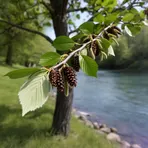
A medium-sized tree that grows near rivers with small woody cones and leaves hairy underneath

A tree with dark bark and leaves that are hairy underneath that grows near rivers
Surface Forms
Morphology
The phrase is fully compositional: 'European' (from Europe) + 'black' (dark-colored) + 'alder' (a type of tree) straightforwardly describe a type of alder tree. This regular adjective + adjective + noun pattern is transparent and cross-linguistically common, so a B1 learner who knows the constituents can infer the meaning.
Etymology
European black alder is a simple picture: European shows where it grows, black describes its dark, often wet-looking bark, and alder is the old name for this kind of tree. So the name today refers to the European tree with dark bark that often grows near rivers and wetlands.

