
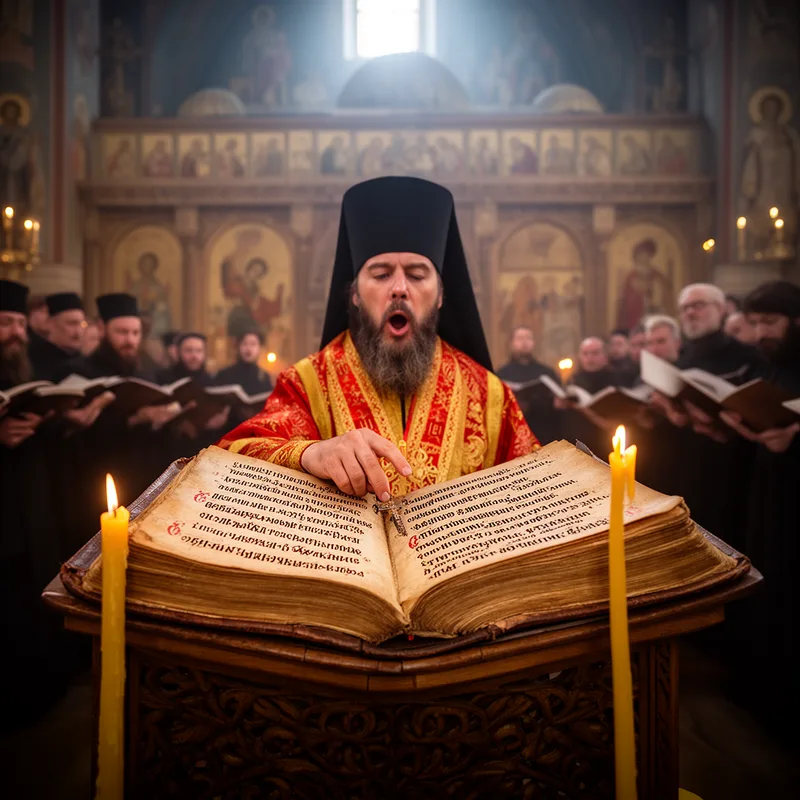
Church Slavic language
- noun
- Literature
- The Church Slavic language is still used in many Orthodox services.
Examples
-
The liturgy was conducted entirely in Church Slavic language.
-
Many ancient manuscripts are written in Church Slavic language.
-
Scholars study the Church Slavic language to understand the origins of Slavic textual tradition.
-
Many scholars study the Church Slavic language for its historical significance.
-
Scholars study the Church Slavic language to understand the origins of Slavic textual tradition.
-
The liturgy was conducted entirely in Church Slavic language.
-
Many scholars study the Church Slavic language for its historical significance.
Synonyms
A literary Slavic language that Orthodox churches use for worship and Bible translation

An old written Slavic language used to translate the Bible for early Christians in the ninth century

An early Slavic language used in the ninth century to translate the Bible and other church texts

A very old Slavic language used in the 9th–11th centuries for early Bible translations

A first Slavic written language used to translate the Bible and church texts in the Middle Ages
Surface Forms
Morphology
The phrase is a direct combination of 'church' (religious institution) + 'Slavic' (relating to Slavic peoples) + 'language', which a B1 learner would naturally interpret as a Slavic language associated with church use. The specialised historical detail (Old Church Slavonic origin) is additional background, but the core meaning 'the Slavic language used in church/liturgy' is compositionally derivable from the constituents.
Etymology
Church Slavic language comes from the 9th century, when the Bible was put into an early Slavic so people could hear it in church. Because that language was used in 'church services' for many centuries, the name now means the special Slavic language used in Orthodox churches.

