
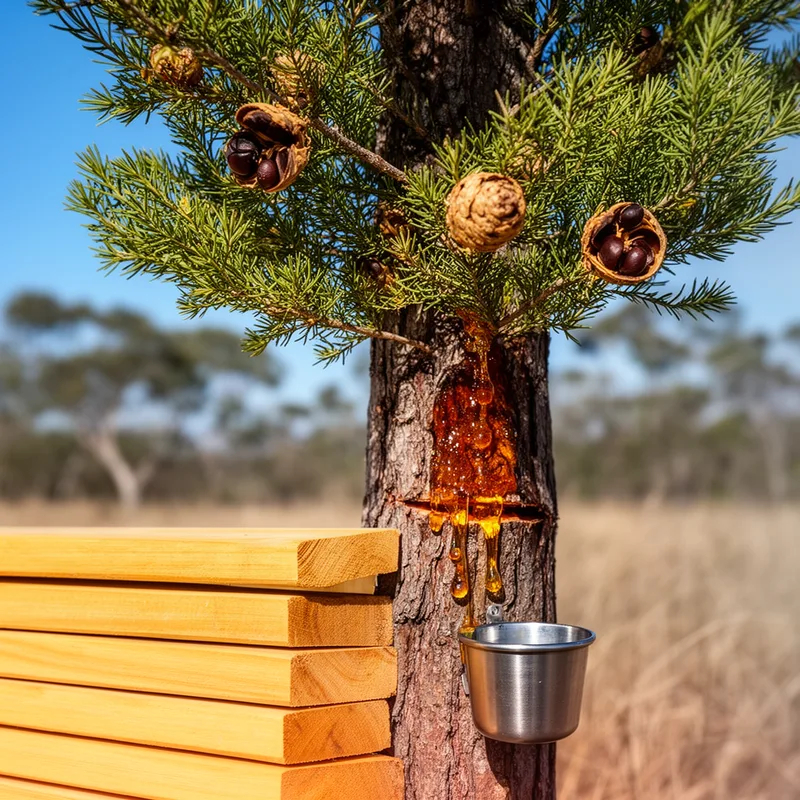
Callitris calcarata
- noun
- Specialized
- The timber from Callitris calcarata is highly prized for its durability.
Examples
-
Many regions in Australia rely on Callitris calcarata for both building materials and resin extraction.
-
The small, scale-like leaves make Callitris calcarata easily distinguishable from other native trees.
-
The Callitris calcarata thrives in arid environments.
-
Many builders prefer using Callitris calcarata for construction.
-
Many regions in Australia rely on Callitris calcarata for both building materials and resin extraction.
-
The timber from Callitris calcarata is highly prized for its durability and is often used in high-quality furniture.
-
The small, scale-like leaves of Callitris calcarata help it withstand harsh conditions in its native habitat.
Synonyms
An Australian tree with small flat scale-like leaves, strong pleasant-smelling wood, and sticky sap

An Australian tree with small flat leaves and hard wood used for building
An Australian evergreen tree with small flat leaves like scales that people use for its wood and resin

Evergreen trees from Australia with needle-like leaves often called cypress pines
An evergreen tree or shrub from Australia that grows well in dry soil and has hard wood
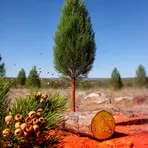
A tree from Australia like a pine with small round cones and scented wood
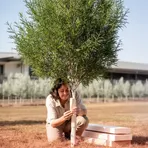
A small Australian tree or shrub with scented wood and small flat leaves
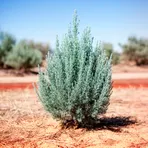
A small tree or shrub from southern Australia with bluish green leaves
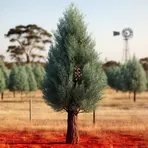
A small tree or shrub from southern Australia in the cypress family
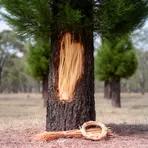
A type of Australian pine tree with fibrous inner bark

A tall Australian pine tree with stringy bark used for timber
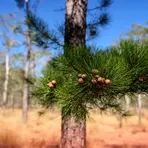
An evergreen tree from eastern Australia with small round cones
Surface Forms
Morphology
Callitris + calcarata
This is a Latin binomial: 'Callitris' names a genus of evergreen trees, so a learner who knows that constituent can infer the phrase denotes a particular kind of tree. However, the species epithet 'calcarata' is a Latin form with no transparent English meaning for a B1 learner, so the full, specific sense cannot be derived from the parts.
Etymology
Callitris calcarata: the name comes from old scientific words — Callitris likely from Greek for 'beautiful' and calcarata from Latin for 'with a spur'. Picture a 'beautiful' conifer with small pointed or spur-like parts on its cones or seeds; that image helps you remember this Australian tree known for its strong wood and resin.

