

Callitris glaucophylla
- noun
- Specialized
- The Callitris glaucophylla thrives in arid regions of Australia.
Examples
-
The fragrant wood of Callitris glaucophylla is valued for its durability.
-
The Callitris glaucophylla is widely used for windbreaks in rural Australia.
-
Botanists identified the specimen as Callitris glaucophylla during their field survey.
-
Many gardeners appreciate the Callitris glaucophylla for its drought resistance.
-
The Callitris glaucophylla tree can grow up to five meters tall in suitable conditions.
-
Because of its unique adaptations, the Callitris glaucophylla is often found in dry, sandy soils.
-
Farmers plant Callitris glaucophylla as an effective barrier against strong winds.
Synonyms
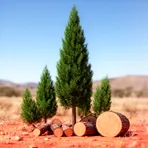
An evergreen tree or shrub from Australia that grows well in dry soil and has hard wood

Evergreen trees from Australia with needle-like leaves often called cypress pines
Surface Forms
Morphology
Callitris + glaucophylla
This is a scientific Latin binomial: while 'Callitris' signals a group of trees, the second element 'glaucophylla' is not an English word and its Latin/Greek roots (e.g. 'glauco-' = bluish, '-phylla' = leaf) are not accessible to a B1 learner. Botanical names are technical and language-neutral but require specialist morphological knowledge, so the species meaning cannot be derived by an average B1 learner from the constituents.
Etymology
Callitris glaucophylla comes from Greek word parts: calli- meaning 'beautiful' and glauco- plus -phylla meaning 'blue-green leaves'. So the name gives a picture of a small, pretty cypress with grey-blue leaves, which helps you remember this tree.

