
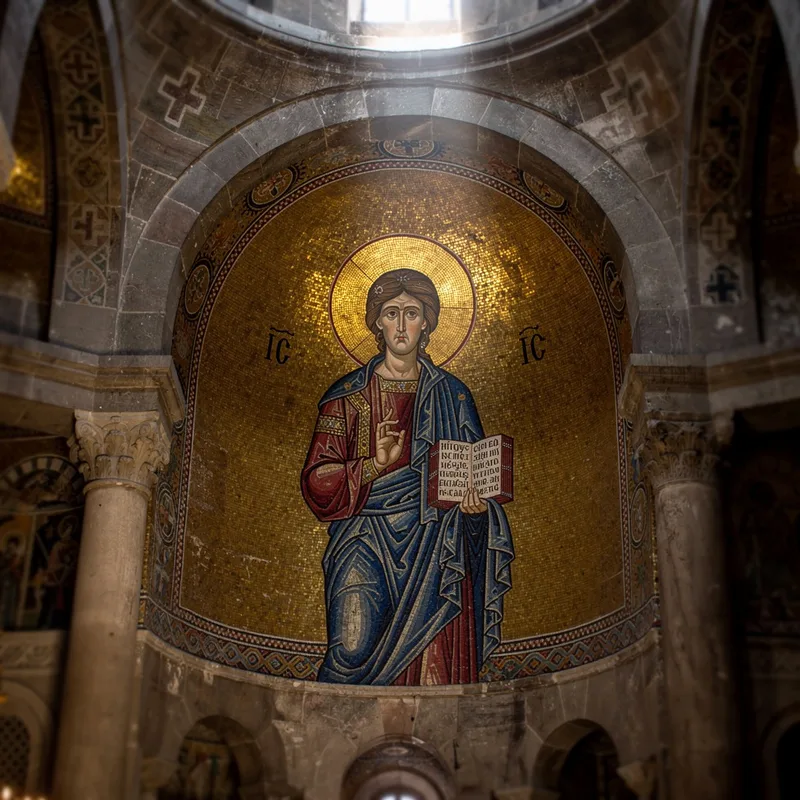
Byzantine
 9
8.9
9
8.9

- adjective
- /bɪˈzæntiːn/
- This would see a Greater Greece stretching from the central Balkans deep into Anatolia, including lands that had been part of ancient Greece and the Byzantine Empire.
- Byzantine Empire
- middle Byzantine period
- Byzantine art
Loading YouTube…
Watch on YouTubeThey didn't really miss the Persian or Byzantine imperial regimes.
- They didn't really miss the Persian or Byzantine imperial regimes.
- And they thought they were looking at perhaps some Byzantine remains.
- Your fallen empire is the Byzantine Empire.
- And indeed there is a kind of aftermath of Byzantine civilization.
- The fall of the Roman Empire, its survival in the east as the Byzantine Empire.
Examples
-
And the churches built in Palermo combined Latin style architecture, Arab ceilings and Byzantine domes, all decorated with exquisite golden mosaics.
-
In the top image you can see on the right a later date church from the Byzantine era.
-
And they thought they were looking at perhaps some Byzantine remains.
-
...which brings us to the Byzantine Empire.
-
It's from the Byzantine era.
-
This Byzantine emperor at least knew how fragile history can be.
-
Perhaps the most dramatic discovery here is a collapsed stable dating to the Byzantine period.
Academic text (2011) -
Rather, classical sources provided the raw material from which uniquely Byzantine images and meanings were created.
Academic text (2008) -
In addition, antique statuary decorated public and private spaces of the Byzantine capital, Constantinople.
Academic text (2008) -
The stunning mosaics in the church are a remarkable example of Byzantine art.
Synonyms

Relating to the city of Constantinople and its history and culture
Compounds
 1
6.3
1
6.3
The eastern part of the Roman Empire centered on Constantinople that lasted from about 395 to 1453
The Christian church in the Eastern Roman Empire with old worship services and traditions


- Specialized
A form of Greek spoken and written in the Byzantine Empire from about 600 to 1200
- Specialized
A style of building with large domes on square bases and many mosaics

A very complex, slow system for a government or organization with too much paperwork

Surface Forms
Morphology
Etymology
Byzantine comes from the city Byzantium, later called Constantinople and now Istanbul, and it describes the art, buildings, and culture made in that eastern empire, famous for big domes and colourful mosaics.