
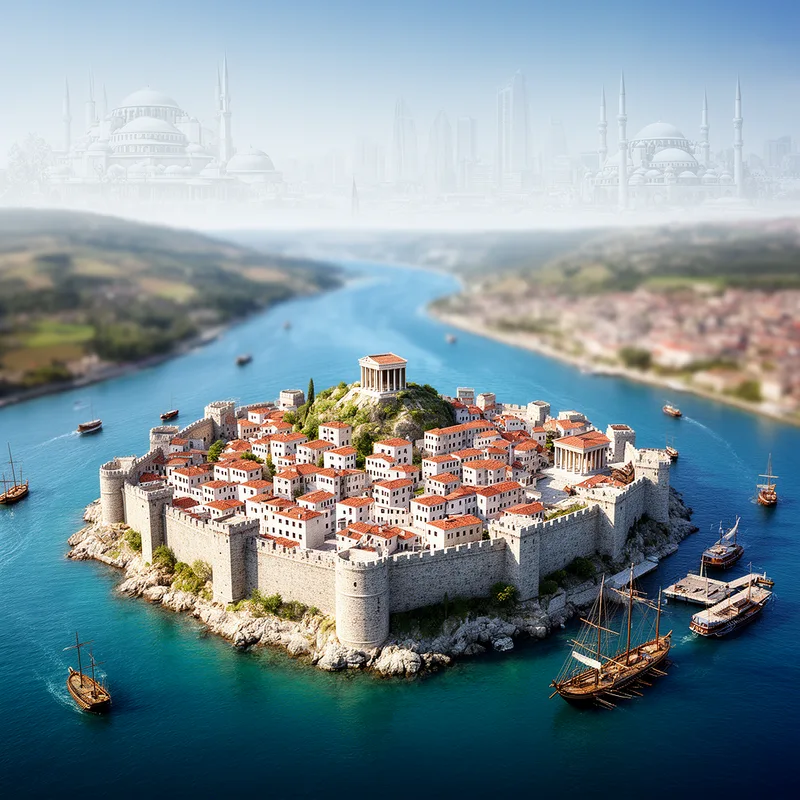
Byzantium
 1
8.7
1
8.7

- proper noun
- /bɪˈzæn.ti.əm/
- Ideally, I would pretend to be a traveling merchant from Byzantium or some other well-developed country (accounting for my incredible clothes).
- the city of Byzantium
Examples
-
A friend of mine who was Dominic's student tells me that he is very proud of his ancestry and likes to tease his students about it by saying, for example, when he is traveling to Turkey that he is "going to Byzantium."
Blog text (21) -
One way is continuity, the continuity of Greece, Rome, Byzantium and Ruse.
-
And therefore I have sailed the seas and come to the holy city of Byzantium.
Blog text (24) -
Where is Byzantium, actually?
-
Even my fascination with Byzantium disturbed him (though he often seemed to share it), as if I were turning my back on the whole European tradition.
Academic text (1999) -
If so, we should revive Sparta then. You cannot call yourself Byzantium, since Constantinople was originally called Byzantium, and so from that the name of the empire came.
Blog text (32) -
In 330 AD, Roman Emperor Constantine I founded a capital on the site of the ancient city of Byzantium.
-
The Europeans probably got their knowledge of explosive weapons and powder from Byzantium via pilgrims and merchants.
-
Philo of Byzantium wrote 'The Seven Sights of the World' in the 2nd century B.C., matching Antipater's list.
Synonyms
 62
3.5
62
3.5
A very large city in Turkey that sits on both Europe and Asia
 13
8.3
13
8.3
A city now called Istanbul that was the capital of the Byzantine Empire
Surface Forms
Etymology
Byzantium comes from the old Greek name Byzantion, which was said to be named after a man called Byzas who founded the site. The city sat on the Bosporus and later became Constantinople and now Istanbul, so Byzantium refers to that ancient city.