
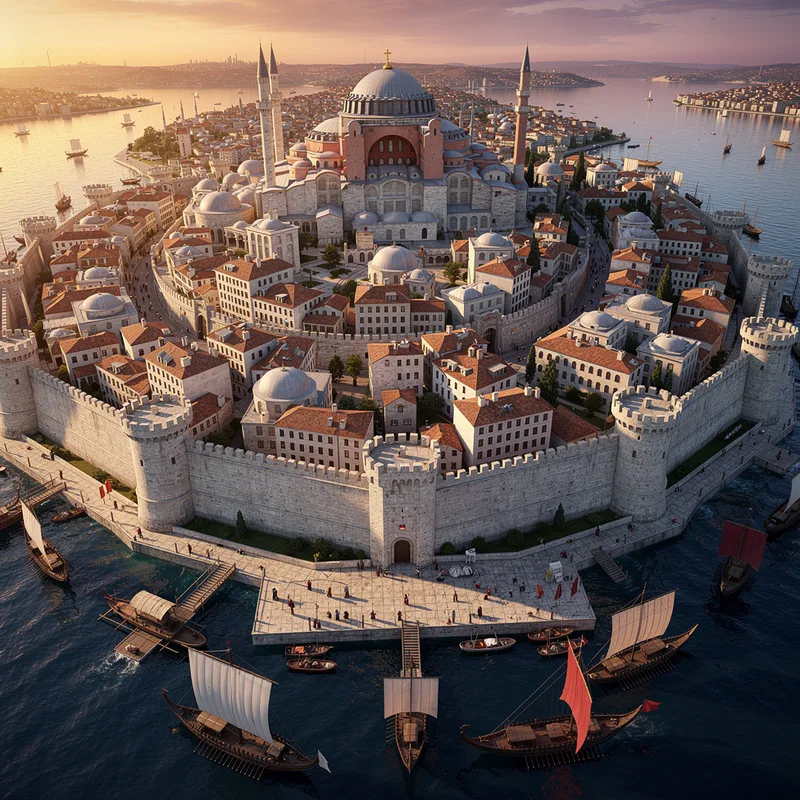
Constantinople
 13
8.3
13
8.3

- proper noun
- /ˌkɒnstənˈɪnəpəl/
- Tracing its origins to the 7th century BC, Constantinople grew into the capital of the Christian Byzantine Empire.
- Council of Constantinople
- Byzantine Constantinople
- Patriarch of Constantinople
Loading YouTube…
Watch on YouTubeBasically various Western European groups took Constantinople.
- Basically various Western European groups took Constantinople.
- There was a siege of Constantinople that fell.
- They, they controlled Constantinople for, for quite a while.
- The Byzantine Empire with its headquarters in Constantinople.
- Most of them acknowledge some kind of Suzeranti of Constantinople.
- And he's like, your ancestor was the Admiral of the Ottoman Navy when they conquered Constantinople.
Examples
-
With the collapse of Constantinople in 1453, the Ottomans unified the Middle East under their dominion.
Academic text (1999) -
During spring 1347, Italian galleys fleeing Kaffa brought infection to Constantinople, where the plague began raging in the summer.
Academic text (2013) -
However, the ultimate prize still remained Constantinople, and a second massive attack was soon prepared.
-
Where is the boat to take the emperor to Constantinople?
-
We must secure Constantinople and the Dardanelles.
-
There's a supply ship back to Constantinople in two days.
-
By the eve of the Turkish conquest, much of Constantinople lay in ruins.
-
The modern era started in 1453 when Constantinople fell to the Ottoman Turks.
Academic text (2017) -
By the eve of the Turkish conquest, much of Constantinople lay in ruins.
-
The modern era started in 1453 when Constantinople fell to the Ottoman Turks.
Synonyms
 62
3.5
62
3.5
A very large city in Turkey that sits on both Europe and Asia

A former name for Istanbul, the largest city in Turkey, used in old books and maps

The old central part of Istanbul with historic buildings and bazaars
Compounds

- Specialized
A meeting of church leaders in 680–681 that says Christ has two wills, divine and human

A large meeting of Christian leaders in 381 that added words about the Holy Spirit to the Nicene Creed

A meeting of church leaders in 869–870 that condemned Photius and helped cause the split between eastern and western churches

A meeting of Christian leaders in 553 that declared some teachings wrong, including writings by Origen
A church council in 680 and 681 that says Christ has a divine will and a human will
Surface Forms
Etymology
Constantinople comes from the emperor's name Constantine and the Greek word polis meaning 'city', so it literally means 'Constantine's city'. That's why the name was used for the old capital of the Byzantine Empire, the city we now call Istanbul.