
American beech
- noun
- /əˈmɛrɪkən biːtʃ/
- Specialized
- In the forest, the towering American beech provides shade for many woodland creatures.
- American beech tree
Examples
-
The major hardwoods are sugar maple, whose brilliant fall foliage attracts numerous visitors in October, American beech, and yellow birch.
Academic text (1998) -
Balsam fir, basswood, hemlock, sugar maple, yellow birch, and American beech are also found here.
Academic text (1998) -
Common trees are red spruce and balsam fir, interspersed with such broad-leaved species as American beech and sugar maple.
Academic text (1998) -
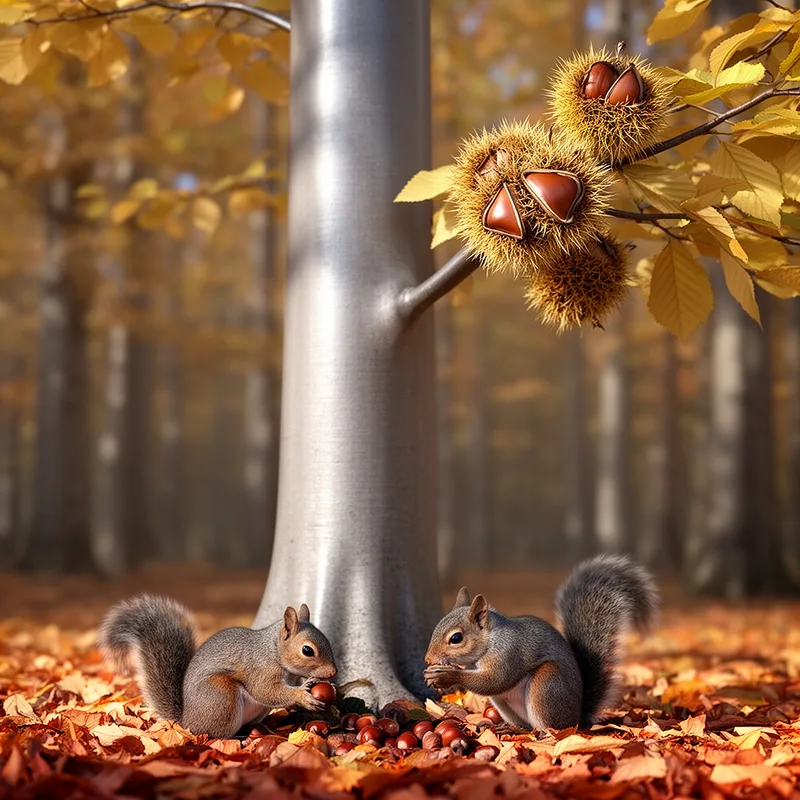
The American beech is known for its smooth gray bark and delicious edible nuts.
-
During autumn, the leaves of the American beech turn a beautiful golden hue, attracting many hikers.
Synonyms

 5
4.3
5
4.3

A large tree with smooth grey bark and small nuts you can eat
 1
3.0
1
3.0
A large tree with smooth grey bark and small nuts inside a prickly cover

A North American tree with light green leaves and nuts you can eat

A beech tree from eastern North America with smooth bark and nuts people and animals eat
A North American forest tree with light green leaves and edible nuts

A North American tree with light green leaves and edible nuts
Surface Forms
Morphology
The phrase 'American beech' is a straightforward adjective + noun combination whose meaning (a beech tree from America) is directly and compositionally derived from 'American' and 'beech'. This kind of geographic modifier + species noun is cross-linguistically common and would be immediately understandable to a B1 learner who knows both constituent words.
Etymology
American beech points to a type of beech tree that grows in North America. People notice its smooth gray bark and edible nuts, so the word 'American' marks it as the beech found in America, which is why the name means 'a North American beech tree'.