

wild onion
 1
3.8
1
3.8

- noun
- /waɪld ˈʌnjən/
- Of course, if you get ahold of a wild onion, that'll help.
- wild onion (Allium)
- wild onion or garlic
- wild onions grow
Examples
-
The cemetery smells of mint and wild onion.
Fiction book (1999) -
We walked through the forest and found delicious wild onions growing near the stream.
-
"That and the dress he bought me once upon a time while I picked sweet wild onions.
Fiction book (1999) -
I think he washed it in the juice of wild onions.
Fiction book (1991) -
What the cattle themselves prefer is wild onions.
Blog text (32) -
"Leaning forward for want of something to do, he knocked the dirt off a wild onion and played it against his hand."
Fiction book (1999) -
Taste the wild onion, it's good. In the distance are some of the Gears' herd of more than a hundred buffalo.
Academic text (2004) -
Barlow smelled wild onions in Lady Wisdom's pasture.
Fiction book (1998) -
Ipa would give him corn cakes smeared with the red jam of prickly pear fruit, or beans and wild onions, or whatever special treat she could find.
Fiction book (1995) -
Under the oaks grew camas (Camassia quamash), wapato (Sagittaria latifolia), wild onions, and other bulb, root, and seed plants.
Blog text (5)
Synonyms

 1
8.8
1
8.8
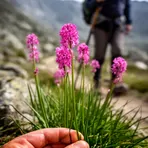
A wild plant with a strong onion smell and pink flowers on a stalk

A wild onion plant with an edible bulb and thin green leaves native to North America

A North American wild onion with a strong onion smell and pink flowers on a leafless stem

A wild onion plant from North America with drooping white or pink flowers

A wild onion plant with drooping white to pink flowers

A wild North American plant with a small onion bulb and drooping white or pink flowers

A wild onion with white to deep red outer skins from California

A wild onion with a strong, sharp smell that grows from bulbs in lawns and fields

A wild plant with broad leaves and white flowers whose leaves smell like garlic and are edible
Surface Forms
Morphology
The meaning is directly compositional: 'wild' (growing naturally) combined with 'onion' (the edible vegetable) yields an onion that grows in the wild. This adjective+noun pattern is common cross-linguistically and follows ordinary English composition rules, so a B1 learner who knows both words will readily infer the MWE meaning.
Etymology
Wild onion comes from the simple picture of an onion growing in the wild instead of in a garden. Because it looks and tastes like a garden onion, people called it 'an onion-like plant that grows naturally'.