
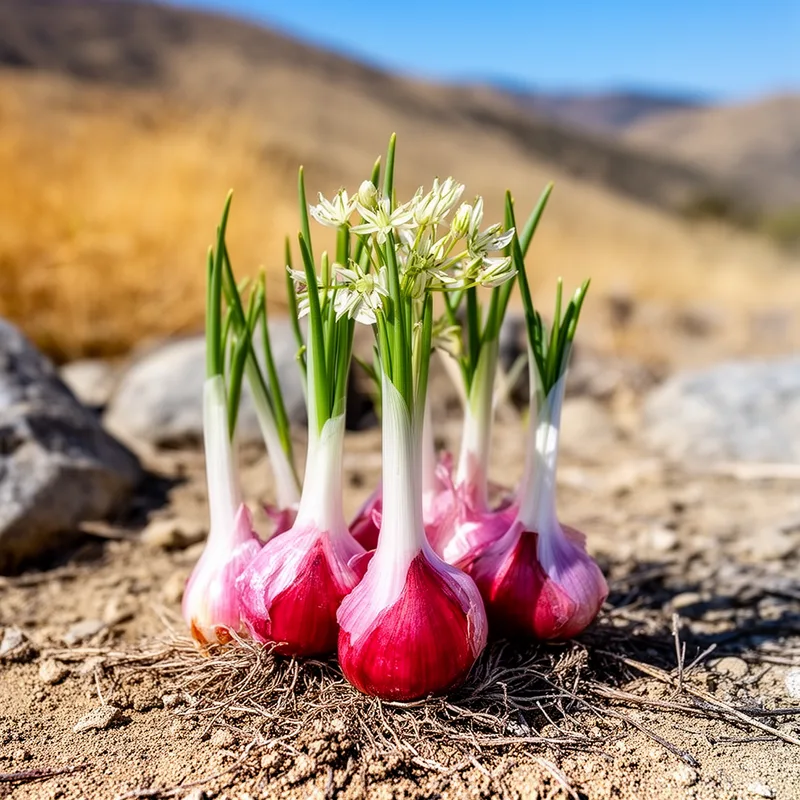
Allium haematochiton
- noun
- Specialized
- The foothills in spring are dotted with blooming Allium haematochiton.
Examples
-
We found several clusters of Allium haematochiton along the California hiking trail.
-
Many botanists study Allium haematochiton for its unique coloration and adaptation to dry climates.
-
I found an Allium haematochiton growing in my garden.
-
The Allium haematochiton has a beautiful red outer tunic.
-
In California, the vibrant blooms of Allium haematochiton add color to the landscape during spring.
-
Hikers often come across patches of Allium haematochiton while exploring the dry foothills of California.
-
The unique structure of Allium haematochiton, with its striking red outer tunic, makes it a favorite among wildflower enthusiasts.
Surface Forms
Morphology
Allium + haematochiton
This is a scientific Latin binomial (genus + species) rather than a normal compositional English phrase; the second element 'haematochiton' is not a common English word and is absent from the dictionary entry. Even though its parts (haema- 'blood', chiton 'tunic') have etymological meaning, that knowledge is specialized and beyond a B1 learner, so the species name’s meaning (‘a particular wild onion’) cannot be derived from the constituents by an average B1 learner.
Etymology
Allium haematochiton comes from Allium, the onion group, and the Greek parts haemato and chiton, which mean 'blood' and 'tunic' because the bulb often has a red outer skin. So, the name describes this wild onion with a deep red outer skin.

