
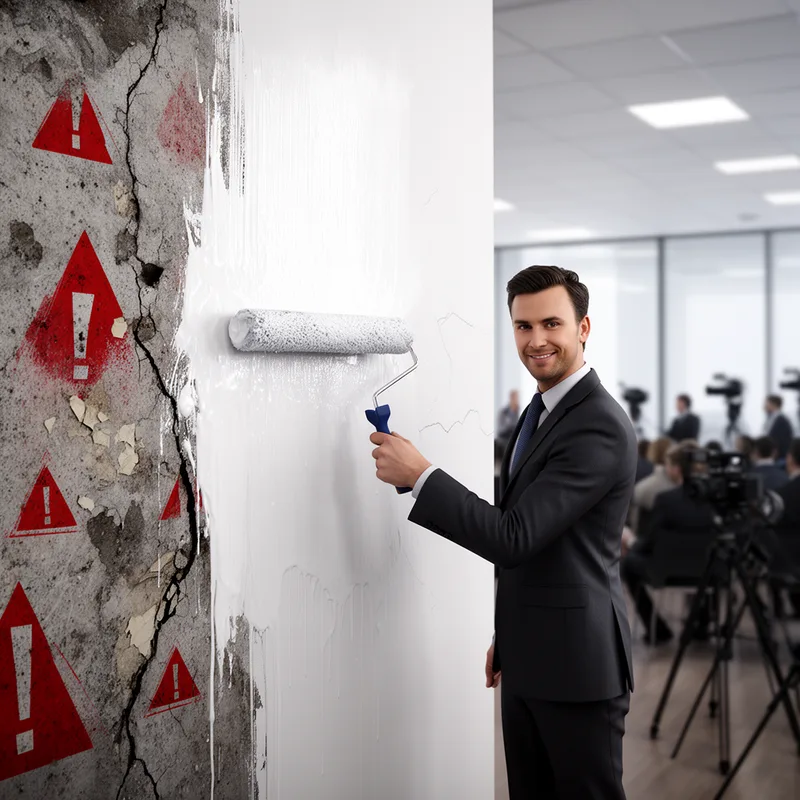
to whitewash the issues
- phrasal verb
- /ˈwaɪtˌwɔʃ ði ˈɪʃuz/
- The politician was accused of trying to whitewash the issues surrounding his controversial decisions.
Examples
-
The manager attempted to whitewash the issues related to employee dissatisfaction during the meeting.
-
General Douglas MacArthur, for example, whitewashed the issue of collaboration with the Japanese, especially in the case of Manuel Roxas, and thus restored to power the pre-war landed elite he needed to re-establish the old order.
Academic text (1993) -
During the investigation, they tried to whitewash the issues that had caused the company's financial troubles.
Synonyms
 23
8.0
23
8.0

To make something sound better to hide problems
 22
6.5
22
6.5
Make a problem or mistake seem less serious by leaving out details
 12
6.0
12
6.0
To hide bad facts to make something seem better
 8
7.7
8
7.7
To hide a problem instead of dealing with it openly
 5
7.9
5
7.9
Try to hide problems instead of dealing with them

To try to hide a scandal by giving wrong information to the public

Treat a problem as less important to avoid dealing with it

To ignore or hide problems instead of dealing with them

To keep secret wrong actions or mistakes from other people

Change facts on purpose to make something seem better
Antonyms


How Deceptive

Surface Forms
Morphology
The verb 'whitewash' already carries the meaning 'to gloss over or cover unpleasant facts', so when combined with 'the issues' the phrase directly means to minimize or conceal those problems. The definite article doesn't change compositionality, and a B1 learner who knows 'whitewash' and 'issue' will readily infer the MWE meaning.
Etymology
The phrase whitewash the issues comes from the old use of whitewash, a thin white paint people used to cover dirty walls and hide stains. So, to whitewash the issues means 'to hide problems or make them seem smaller' instead of fixing them.