

velvet bean
- noun
- Farmers often grow velvet bean as a green manure to improve soil fertility.
Examples
-
From the Hondurans, we learned about nitrogen-fixing velvet beans.
Academic text (1998) -
When Brad Morris walks into the seed storage room at his U.S. Department of Agriculture lab, he often wonders what pharmaceutical secrets may be hidden inside the velvet beans, jack beans, and winged beans tucked away in paper bags in the 40 degrees F air.
Academic text (1996) -
And scientists in Italy have requested velvet bean, Mucuna pruriens, a source of the dopa that's converted by the brain to the neurotransmitter dopamine.
Academic text (1996) -
Velvet bean also contains bufotenine (a cholinesterase inhibitor) and serotonin (a brain neurotransmitter that may be involved in learning, sleep, and control of moods).
Academic text (1996) -
Winged bean, jack bean, and velvet bean (also called cowitch) sound odd enough, but how about snout bean, ringworm bush, and fish poison bean?
Academic text (1996) -
The velvet bean plant thrives in tropical climates, producing long clusters of purplish flowers.
-
During the summer, you can see fields of velvet bean swaying in the wind, offering a beautiful sight.
Synonyms

A one-year woody climbing plant with purple flower clusters and hairy pods grown to improve soil and feed animals

A fast-growing vine with purple flowers and hairy pods used as food for animals and to improve soil

A tropical vine grown as a cover crop to improve soil and feed animals

A climbing plant with purple flowers and hairy pods grown to enrich soil and feed animals
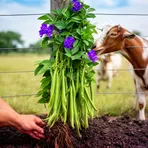
A climbing plant with purple flowers and long hairy pods used to improve soil and feed animals

A climbing plant people grow to feed animals and improve soil

A climbing plant from Asia with long purple flower clusters and hairy pods used to improve soil and feed animals

A woody climbing plant with purple flowers and hairy pods that farmers grow to feed animals and improve soil
Surface Forms
Morphology
The compound is an adjective + noun naming pattern where 'velvet' describes a textured quality of the bean; a B1 learner who knows 'velvet' (soft, smooth) and 'bean' (a legume seed) can infer this refers to a type of bean with a velvety or hairy surface. Plant names formed this way are cross-linguistically common and the meaning is directly compositional rather than idiomatic.
Etymology
Velvet bean gets its name from the plant's soft, very hairy seed pods that look and feel like velvet, and from it being a type of bean plant. Farmers plant it as a 'cover crop' or 'green manure' and let animals graze it, so the name reminds us of a bean plant with velvet-like pods used on farms.

