

Mucuna aterrima
- noun
- Specialized
- Farmers in southern states use Mucuna aterrima as green manure and for grazing livestock.
Examples
-
The distinctive hairy pods of Mucuna aterrima can cause skin irritation when handled without gloves.
-
The Mucuna aterrima vine grows rapidly in tropical climates.
-
Mucuna aterrima is often cultivated as a cover crop to improve soil fertility in tropical regions.
-
Farmers often plant Mucuna aterrima to improve soil quality.
-
Mucuna aterrima is often cultivated as a cover crop to improve soil fertility in tropical regions.
-
Farmers in southern states use Mucuna aterrima as green manure and for grazing livestock.
-
Farmers often plant Mucuna aterrima to improve soil quality.
Synonyms

A one-year woody climbing plant with purple flower clusters and hairy pods grown to improve soil and feed animals

A fast-growing vine with purple flowers and hairy pods used as food for animals and to improve soil

A tropical vine grown as a cover crop to improve soil and feed animals

A climbing plant with purple flowers and hairy pods grown to improve soil and feed animals

A climbing plant from Asia with long purple flower clusters and hairy pods used to improve soil and feed animals
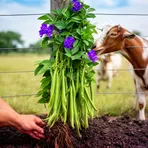
A climbing plant with purple flowers and long hairy pods used to improve soil and feed animals

A woody climbing plant with purple flowers and hairy pods that farmers grow to feed animals and improve soil

A climbing plant people grow to feed animals and improve soil
Surface Forms
Morphology
Mucuna + aterrima
This is a botanical Latin binomial: combining the genus name 'Mucuna' with the species epithet 'aterrima' signals that it is a particular species of Mucuna, so a learner who knows the constituents can infer it names a species. However, the specific biological traits and uses in the full definition are not derivable from the parts (and 'aterrima' is not an English word), so the full meaning is only partially predictable.
Etymology
The plant name Mucuna aterrima likely comes from a local word for a bean and the Latin word aterrima, meaning 'very dark'. So the name paints a simple image of a very dark Mucuna plant, which helps you remember it is a bean-like vine with dark features.

