

Stizolobium deeringiana
- noun
- Specialized
- Farmers in the southern United States often plant Stizolobium deeringiana to enrich the soil between crop cycles.
Examples
-
The dense, hairy pods of Stizolobium deeringiana can be seen hanging from the vine in late summer.
-
Cattle graze on fields of Stizolobium deeringiana, which serves as both forage and green manure.
-
The garden features Stizolobium deeringiana prominently.
-
Farmers often grow Stizolobium deeringiana for its benefits.
-
Farmers in the southern United States often plant Stizolobium deeringiana to improve soil health and provide grazing for livestock.
-
Cattle graze on fields of Stizolobium deeringiana, which is cultivated for its value as green manure.
-
The long clusters of purplish flowers from Stizolobium deeringiana attract various pollinators throughout the summer.
Synonyms

A one-year woody climbing plant with purple flower clusters and hairy pods grown to improve soil and feed animals

A climbing plant with purple flowers and hairy pods grown to enrich soil and feed animals

A tropical vine grown as a cover crop to improve soil and feed animals

A climbing plant with purple flowers and hairy pods grown to improve soil and feed animals
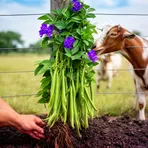
A climbing plant with purple flowers and long hairy pods used to improve soil and feed animals

A woody climbing plant with purple flowers and hairy pods that farmers grow to feed animals and improve soil

A climbing plant people grow to feed animals and improve soil

A climbing plant from Asia with long purple flower clusters and hairy pods used to improve soil and feed animals
Surface Forms
Morphology
Stizolobium + deeringiana
This is a Latin binomial (a scientific species name). Even if a learner recognized 'Stizolobium' as a genus label, the specific epithet 'deeringiana' carries no transparent everyday meaning and the detailed description of the plant cannot be inferred from the parts, so the overall name is not compositional for a B1 learner.
Etymology
Stizolobium deeringiana may come from the way plant names are made: Stizolobium points to the vine's long, hairy seedpods, and deeringiana is 'named after' a person called Deering who first described or introduced the plant. So the name helps you remember a hairy-podded vine linked to that person.

