

universal meter
- noun
- /ˌjunɪˈvɜrsəl ˈmiːtər/
- Archaic
- The universal meter was defined as the length of a free seconds pendulum and was used in the 17th century.
Examples
-
In 1675, Tito Livio Burattini introduced the universal metre.
-
The universal meter was designed to provide a consistent standard of length based on the seconds pendulum.
-
Burattini proposed the universal meter as an alternative to other units of measurement in the 17th century.
-
Unlike the modern metre, the universal meter is slightly longer due to its definition.
-
The universal meter was once a standard for measuring length.
-
Tito Livio Burattini introduced the universal meter in 1675 to standardize measurements of length.
-
Many scientists relied on the universal meter as a consistent unit of length before the modern metre was adopted.
Synonyms

A historical measure of length based on a swinging weight that completes one swing in one second
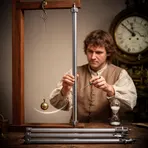
A historical measure of length equal to the length of a pendulum that takes one second to swing
Surface Forms
Morphology
The phrase transparently combines 'universal' and 'meter', so a B1 learner who knows both words will reasonably infer it refers to a kind of measuring unit intended to be universal. However, the precise historical/technical sense (a pendulum-based former unit differing slightly from the modern metre) is specialised and not predictable from the constituents alone, so full meaning requires prior exposure or explanation.
Etymology
The noun universal meter comes from a 17th-century idea to make one 'universal' meter by using a swinging weight that marked seconds. A man called Tito Livio Burattini suggested using the length of that swing as a fixed 'unit of length', so the universal meter was this old standard and is a little longer than the modern metre.

