
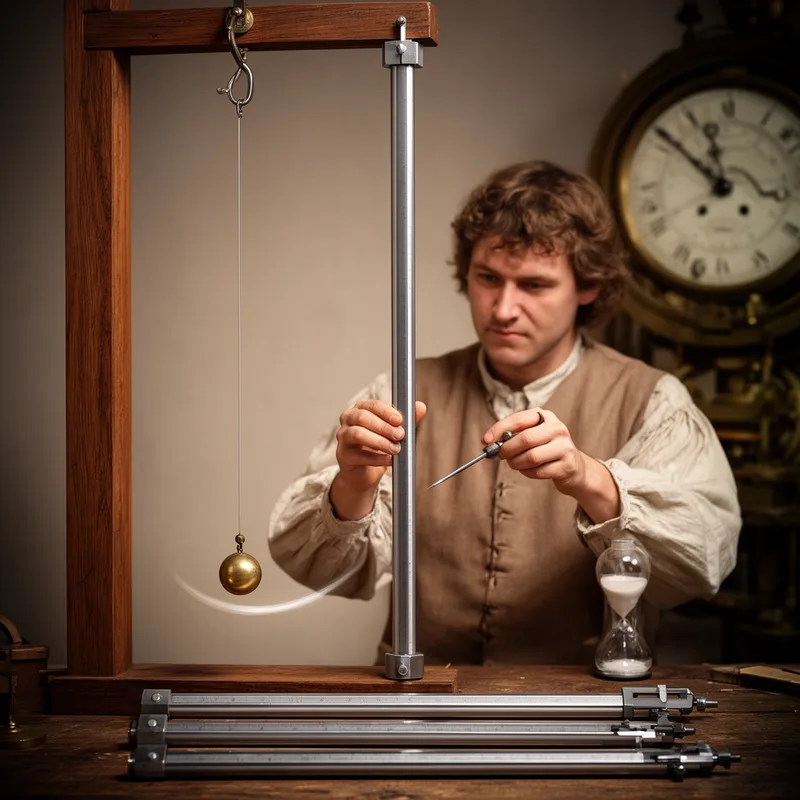
catholic meter
- noun
- /ˈkæθəlɪk ˈmiːtər/
- Archaic
- Unlike the modern metre, the catholic meter was defined by the length of a seconds pendulum.
Examples
-
Burattini’s catholic meter was one of several early attempts to establish a natural standard for measurement.
-
The catholic meter was conceived as a universal standard of length in the seventeenth century.
-
The catholic meter was used in various scientific studies.
-
In the 17th century, the catholic meter played a crucial role in measurements.
-
Burattini’s catholic meter was introduced in 1675 as a standard unit of length based on the free seconds pendulum.
-
The catholic meter differs from the modern metre by approximately half a centimetre, reflecting historical measurement methods.
-
Many scientists adopted the catholic meter during the seventeenth century for its innovative approach to defining length.
Synonyms
A former unit of length based on a pendulum that swings once in one second

A historical measure of length based on a swinging weight that completes one swing in one second
Surface Forms
Morphology
The components 'catholic' (meaning 'universal' or 'embracing a wide variety') and 'meter' (a unit of length) give a partial cue — a learner might guess this refers to a general or standard unit of length. However, the precise historical/technical sense (the length of a free seconds pendulum introduced by Burattini) is specialized and not derivable from the constituents alone, so full meaning requires prior exposure or domain knowledge.
Etymology
Catholic meter comes from a 17th-century idea to set a single length for everyone: catholic meant 'universal' and meter meant a unit of length. Burattini suggested using a pendulum that swung in 'one second', so the catholic meter was the length of that pendulum and was meant to be a common standard.

