
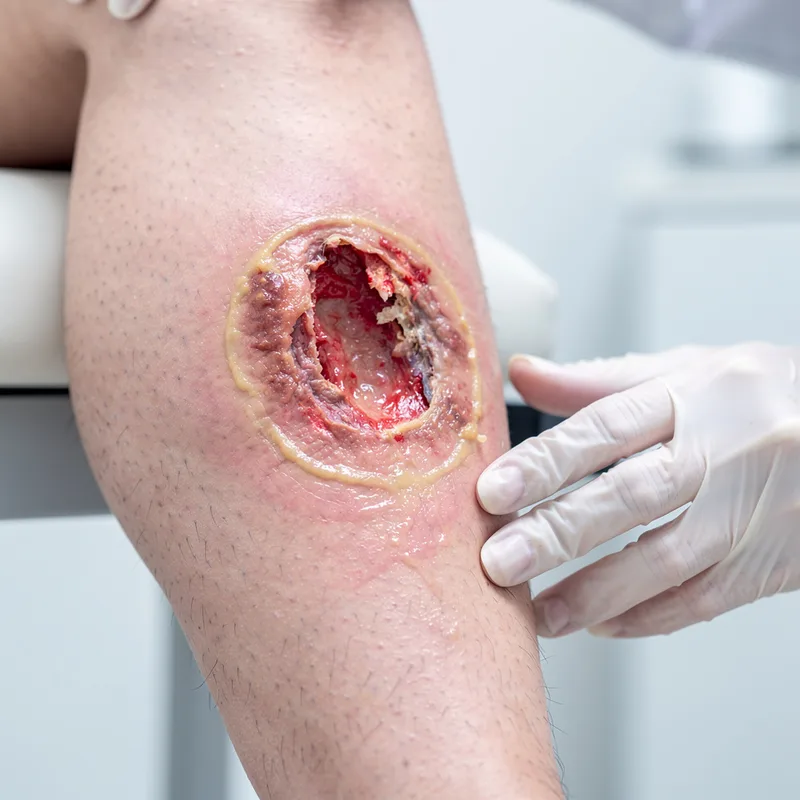
to ulcerate
 2
8.6
2
8.6

- verb
- /ˈʌlsəˌreɪt/
- Specialized
- His mood levellers give him this ulcerating skin rash.
- ulcerated lesion
- ulcerated nodule
- ulcerated skin
Examples
-
After being untreated for a long time, the burn became ulcerated and required medical attention.
-
Injection will cause a lot of pain and it ulcerates.
Academic text (2007) -
All my mates are ulcerated at the throat; the punctures are deep and ugly.
Fiction book (1998) -
Many had ulcerating soles on their legs or feet, sores that stank.
Fiction book (1994) -
An indirect laryngoscopy revealed a scarred and ulcerated epiglottis.
Academic text (2007) -
The mucosa was ulcerated, and the lamina propria and superficial muscular layer of the tongue were invaded.
Academic text (2005) -
The doctor warned that if the sore remained untreated, it could easily become ulcerated.
-
Patients with diabetes often have wounds that can become ulcerated if not properly managed.
Antonyms
How Severe
- Specialized
3
9.8

- Specialized
2
8.6
- Specialized
13
5.3
17
3.4
Surface Forms
Morphology
Etymology
The word ulcerate comes from the old Latin word ulcus, which means 'sore' and is the same root as the common word ulcer. So, to ulcerate is for skin or body tissue to become a 'sore' or an 'open sore'.