
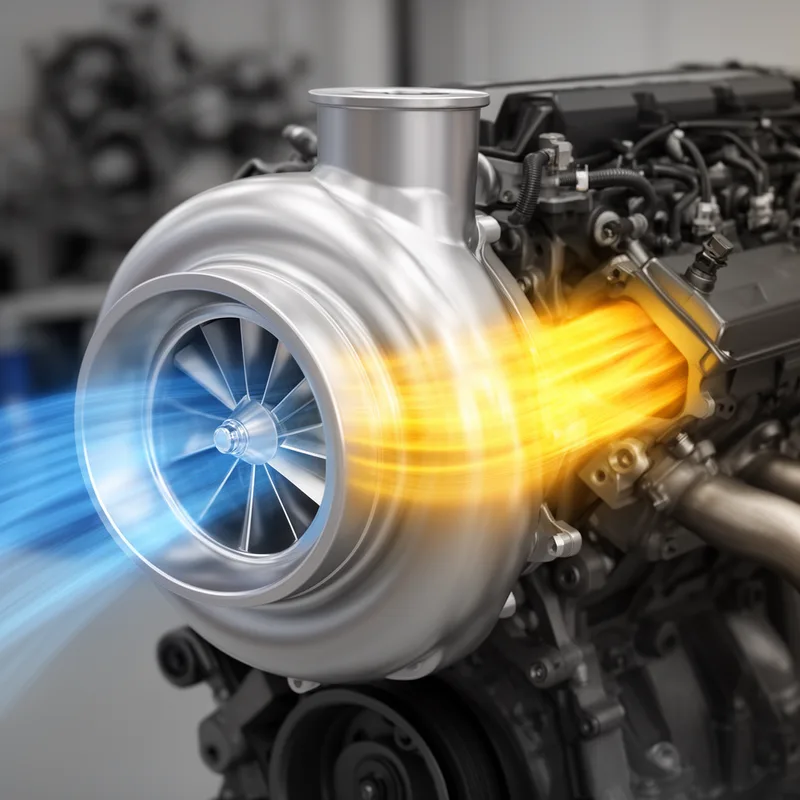
turbocompressor
- noun
- /ˌtɜrbəʊkəmˈprɛsər/
- Specialized
- In industrial applications, a turbocompressor is used to boost the pressure of gases for various processes.
Examples
-
While working at Joy/Cooper Turbocompressor Co., his primary work included new product design and development, and aerodynamic design of compressors.
Academic text (2001) -
Another challenge is to build a turbocompressor that is small enough to operate efficiently.
Academic text (1994) -
A turbocompressor sends natural gas or gasified coal into the fuel cell.
Academic text (1994) -
Anyhow, my next major milestone for the thesis is to produce a draft second chapter by Christmas, which will deal in more detail with the collaboration between Metrovick and the RAE, and the evolution of the MV work from an experimental turbocompressor to a flight-capable jet engine.
Blog text (29) -
The turbocompressor increases the engine's efficiency by compressing the intake air, leading to better performance.
-
Engineers designed a new turbocompressor that optimizes airflow to enhance fuel efficiency in vehicles.
Synonyms

 21
3.9
21
3.9

A device that forces extra air into an engine to increase power
 20
4.7
20
4.7
A machine that increases air or gas pressure by making its space smaller
 2
3.9
2
3.9
A machine that pushes air to a higher pressure to power tools or inflate things
 1
5.1
1
5.1
A device that forces extra air into an engine to make it more powerful
How Boosted
- Specialized
6
6.8

- Specialized
- Specialized
1
5.1
- Specialized
20
4.7
Surface Forms
Morphology
turbocompressor = compressor (transparent) = turbo + compress + or
The meaning is directly derived from 'turbo' (turbine/boost) + 'compressor' (a device that compresses), which matches standard technical formation.
Etymology
The word turbocompressor joins two parts: turbo, from a root meaning 'whirl' and seen in turbine, and compressor, from a root meaning 'press together' and like compress. So a turbocompressor is a machine that spins and squeezes air, raising its pressure to help engines or systems run more powerfully.