
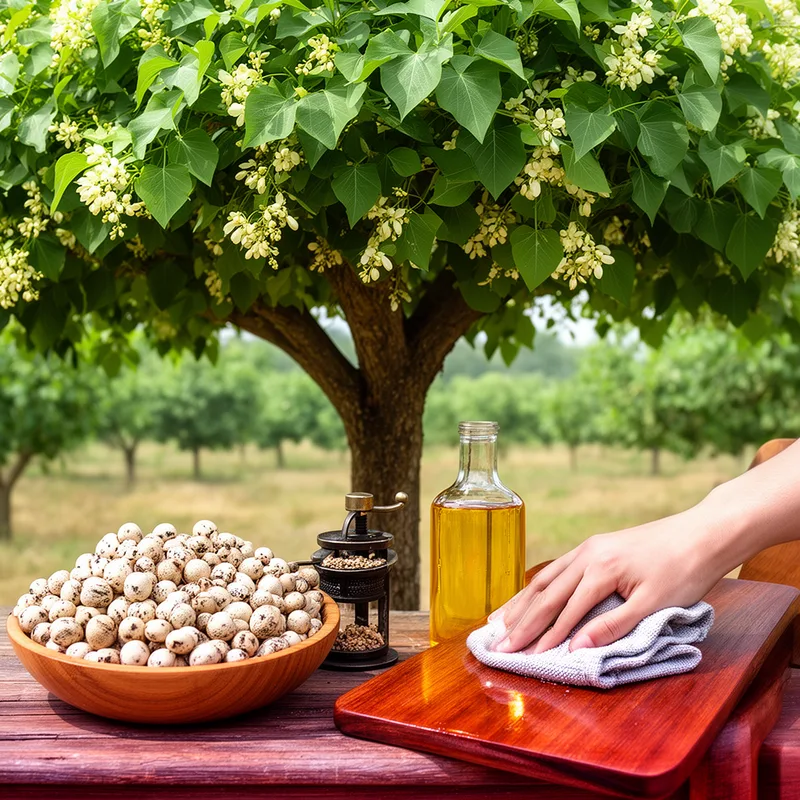
tung


 1
9.9
1
9.9
- noun
- /tʌŋ/
- And I think that the tung oil will give me what I'm looking for at a lower impact, let's say.
Examples
-
Examples are the Polish settlers in Misiones who started growing tung and tea, crops never before cultivated in Argentina or Poland.
Academic text (2000) -
Nearly three-quarters of the land still producing yerba mate and about half of the land in tea and tung have suffered moderate to severe erosion (Casas et al. 1988, 133).
Academic text (2000) -
I need a new brush for this tung oil.
-
Manchurian tung oil.
-
The craftsman used tung oil to achieve a smooth finish on the wooden table.
-
After applying the tung oil, the wood beautifully highlighted its natural grain.
-
Many professionals prefer tung oil for its durability in wood coating applications.
Synonyms

A tree from China with seeds that make oil used to finish wood and make paint
A Chinese tree that loses its leaves and has seeds used to make tung oil
A Chinese tree that produces seeds used to make tung oil for varnish and paint
Compounds

Surface Forms
Etymology
The word tung comes from a Chinese name for a tree whose seeds give a special oil used to finish wood and paint. English borrowed the name with the oil, so tung now refers to that tree and the 'tung oil' used on furniture.