
Aleurites fordii
- noun
- Specialized
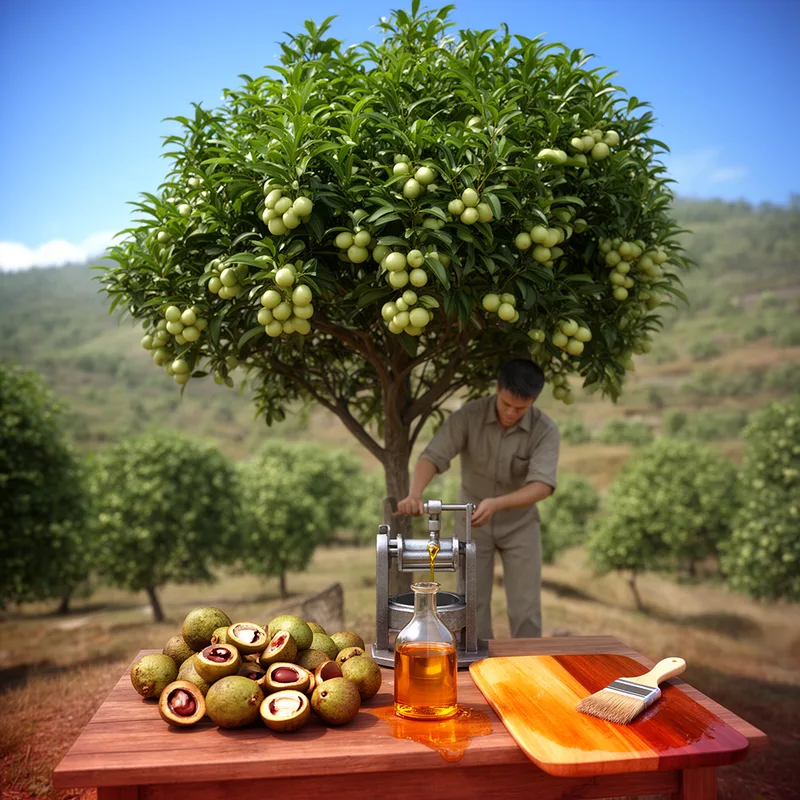
- The seeds of the Aleurites fordii are pressed to produce tung oil.
Examples
-
Many people use Aleurites fordii for making varnishes.
-
The Aleurites fordii tree is native to China.
-
Aleurites fordii has become a significant crop in several subtropical regions.
-
Farmers cultivated Aleurites fordii extensively for its valuable oil.
-
Farmers cultivated Aleurites fordii extensively to harvest its seeds for tung oil.
-
The seeds of the Aleurites fordii tree are prized for their oil used in paints and varnishes.
-
Many manufacturers rely on Aleurites fordii for producing high-quality tung oil.
Synonyms


 1
9.9
1
9.9
A Chinese tree whose seeds make oil used to protect and shine wood
A tree from China with seeds that make oil used to finish wood and make paint
A Chinese tree that loses its leaves and has seeds used to make tung oil
Surface Forms
Morphology
Aleurites + fordii
This is a scientific Latin binomial: knowing 'Aleurites' as a plant genus allows a learner to infer the phrase refers to a species of that genus (i.e., a plant). However, the specific properties (that it is a Chinese tree producing tung oil) and the species epithet 'fordii' are not derivable from the constituents, so only the general category is predictable.
Etymology
Aleurites fordii may come from the Greek word 'aleuron' meaning 'flour', because the tree's leaves and seeds can look soft and powdery, and fordii shows it was 'named after' a person called Ford. So the name helps you remember this Chinese tree whose seeds are pressed to make tung oil.