

tropical year
- noun
- /ˈtrɒpɪkəl jɪr/
- Specialized
- From our earthly perspective during the course of a solar or tropical year, the sun describes a circle in the sky; this circle is called the ecliptic.
Examples
-
The solar (or tropical) year is both divided by and defined by the solstices, not by the equinoxes.
Academic text (1990) -
A tropical year is the time it takes for Earth to orbit the Sun, lasting about 365.24 days.
-
During a tropical year, the Earth completes one full revolution around the Sun from one vernal equinox to the next.
-
The length of a tropical year is crucial for determining the timing of seasons and agricultural cycles.
Synonyms

 1
3.7
1
3.7

The time it takes the Earth to go once around the Sun, about 365 days
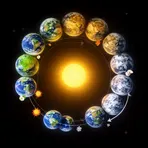
The time Earth takes to go from one spring equinox to the next, about 365.24 days

The time the Earth takes to go once around the Sun from one spring equinox to the next
Surface Forms
Morphology
Although the components 'tropical' and 'year' are individually transparent, the established astronomical sense of 'tropical year' (the interval between vernal equinoxes) cannot be derived from 'tropical' meaning 'related to the tropics' plus 'year.' A B1 learner who knows the words would most likely interpret it as 'a year in the tropics,' so the correct technical meaning is not predictable from the parts.
Etymology
Tropical year gets its name from the word tropical, which comes from an old word for 'turn' because people saw the Sun seem to 'turn' at the tropics. The tropical year is the time it takes the Sun to come back to the same point in the 'seasons', so the name shows this year is tied to our seasons.