
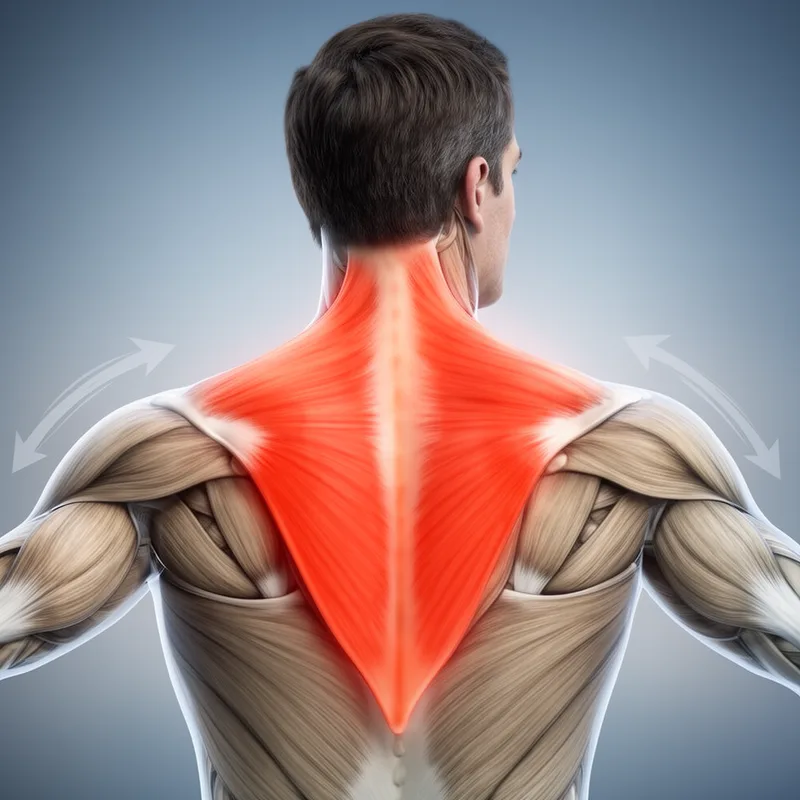
trapezius muscle


 1
5.2
1
5.2
- noun
- /trəˈpiːziəs ˈmʌsl/
- Specialized
- A tight trapezius muscle can cause discomfort and limit your range of motion in the neck.
- the right trapezius muscle
Examples
-
The trapezius muscle has upper, middle, and lower parts.
Academic text (2006) -
Figure A: Subdermal-needle recording electrodes are placed in the trapezius muscle.
Academic text (2006) -
Resection of the SAN can result in shoulder syndrome as a result of denervation of the trapezius muscle.
Academic text (2006) -
The trapezius muscle is responsible for the primary rotatory and supportive actions of the shoulder girdle mechanism.
Academic text (2006) -
A tender 1-cm lymph node was palpated at the superior edge of the trapezius muscle.
Academic text (2006) -
The trapezius muscle helps lift your shoulders when you shrug.
-
When exercising, it's important to engage your trapezius muscle to support your shoulders.
Synonyms
 2
8.4
2
8.4
A large triangular muscle on each side of the upper back and neck that moves shoulders and supports arms

A large flat muscle on the upper back and shoulder that helps move the shoulder and neck

A flat triangular part at the top of the back that moves and supports the shoulder and arm
Surface Forms
Morphology
The term is directly compositional: 'trapezius' names a particular triangular muscle and 'muscle' denotes the body tissue that produces movement, so combining them simply specifies that particular muscle. Anatomical naming follows transparent, cross-linguistic patterns, so a learner who knows both constituents can infer the meaning.
Etymology
Trapezius muscle comes from a Greek word for a small table or four-sided shape, because the flat area on the upper back looks a bit like a little table. That's why the name refers to the muscle that helps 'move the shoulders' and 'rotate the neck'.