
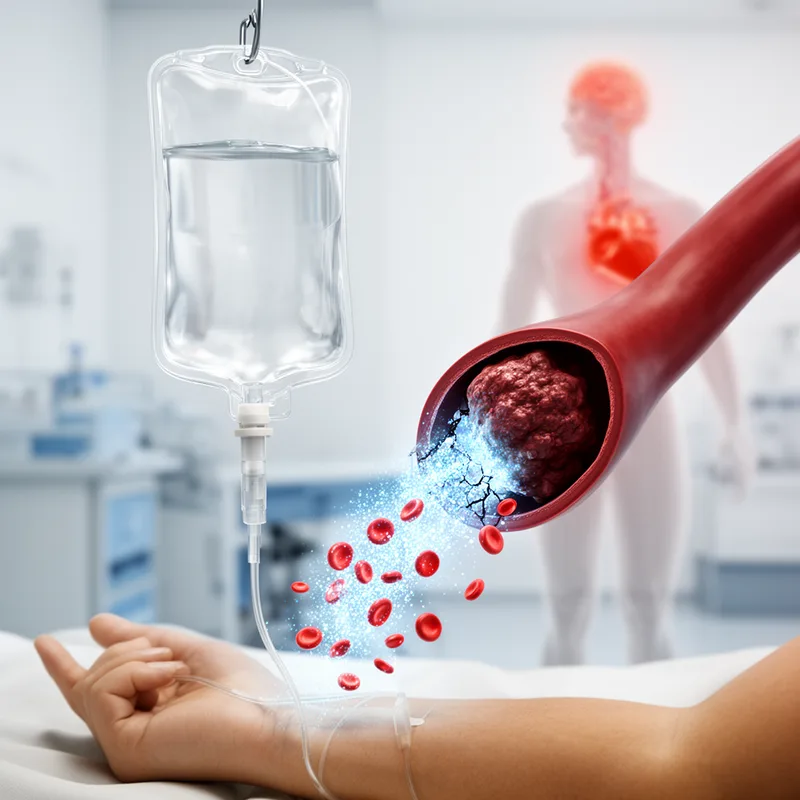
tissue plasminogen activator
- noun
- /ˈtɪʃu ˈplæzmɪnədʒən ˈæktɪveɪtər/
- Specialized
- Patients with heart attacks often receive tissue plasminogen activators quickly.
Examples
-
The doctor administered tissue plasminogen activator during the emergency.
-
The doctors administered tissue plasminogen activator to dissolve the blood clot quickly.
-
Early use of tissue plasminogen activator can significantly improve stroke outcomes.
-
Researchers are studying new ways to deliver tissue plasminogen activator to patients more effectively.
-
Doctors often use tissue plasminogen activator to help dissolve clots during a heart attack.
-
In emergency rooms, tissue plasminogen activator is administered quickly to stroke patients to restore blood flow.
-
The use of tissue plasminogen activator has been shown to significantly improve recovery after a heart attack.
Synonyms

 1
8.4
1
8.4

A medicine made by bacteria that breaks up blood clots


 1
7.7
1
7.7
A medicine that dissolves blood clots to treat heart attacks and strokes
 1
9.9
1
9.9
A natural protein made in the kidneys that helps break down blood clots

A substance made by the body that helps break down blood clots

A drug that breaks up blood clots to restore blood flow during a heart attack or stroke
Surface Forms
Morphology
tissue + plasminogen + activator
The phrase is compositionally built from its parts: 'tissue' + 'plasminogen' + 'activator' literally denotes an agent that activates plasminogen in or from tissue. Although it is a specialized medical term unfamiliar to many learners, the meaning is directly derivable from the constituent words and standard noun-compound structure, so someone who knows each component can infer its function.
Etymology
The medical name tissue plasminogen activator describes what it does: it helps a natural substance called plasminogen in body tissue 'turn on' and 'break down' a blood clot. That's why the drug is used to 'dissolve' clots quickly in heart attacks and strokes.