
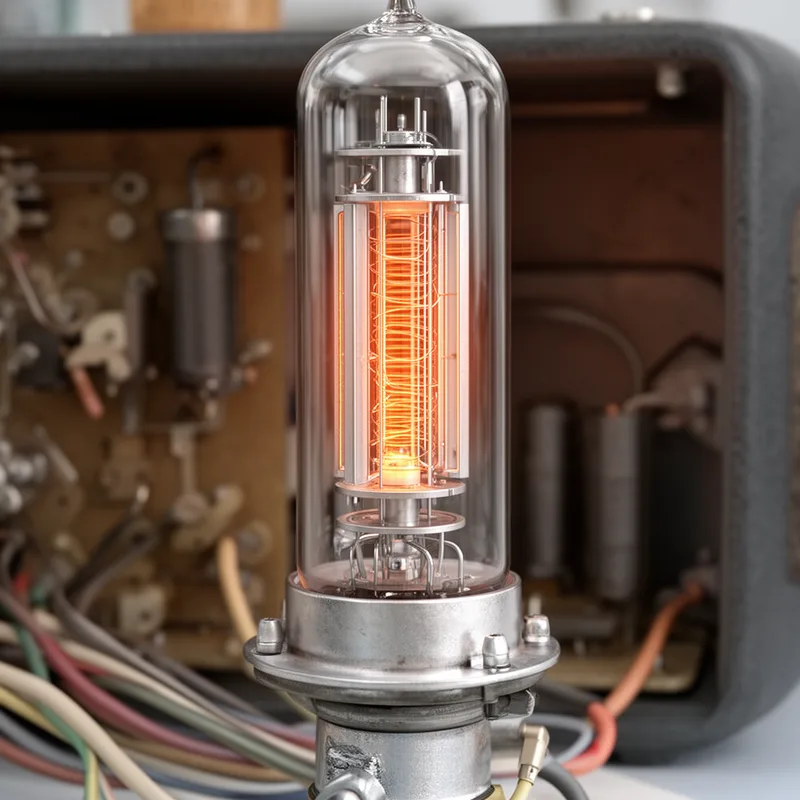
thermionic tube
- noun
- /ˌθɜrˈmiːɒnɪk tuːb/
- Archaic
- Before transistors, engineers often relied on thermionic tubes for electronic signal processing.
Examples
-
Who has seen a thermionic tube?
Blog text (22) -
The old radio used a thermionic tube to amplify the sound.
-
The scientist explained how a thermionic tube works in controlling electric current.
Synonyms

 65
8.8
65
8.8

An old glass part used in radios and sound equipment to make sound louder
 5
5.3
5
5.3
A glass or metal tube with empty space inside that controls electricity

A glass or metal device that controls electric current in old radios and televisions

A glass or metal tube that uses heat to make electricity flow without air
An electronic device in a sealed glass tube that controls electric current in old radios
Surface Forms
Morphology
The compound is compositionally transparent: 'thermionic' specifies the operating principle (electron emission from heated materials) and 'tube' names the vacuum electronic device, so the combined meaning ('a tube that uses thermionic emission') is directly derivable. Because both constituents describe the mechanism and the object, a learner who knows those words can infer the MWE's meaning without prior exposure.
Etymology
Thermionic tube comes from a simple image: heat (the therm part) makes tiny 'electrons' move, and the glass tube keeps them in a 'vacuum' so their flow can be controlled. So the name tells us it uses heat to make and control electric current.